
| Algaroba |

|
 |

|


| File size | 670118 |
| Original date | 4/13/05 6:02 PM |
| Resolution | 2048 x 1536 |
| Flash | Flash fired, auto |
| Focal length | 5.4mm |
| Exposure time | 1/60s |
| Aperture | 4.8 |
| Focus Distance | |
| Metering Mode | Partial |
| Camera make | NIKON |
| Camera model | E3700 |
| Sensor type |
 |
 ntroduced ntroduced |
 |
 |
Photo: |
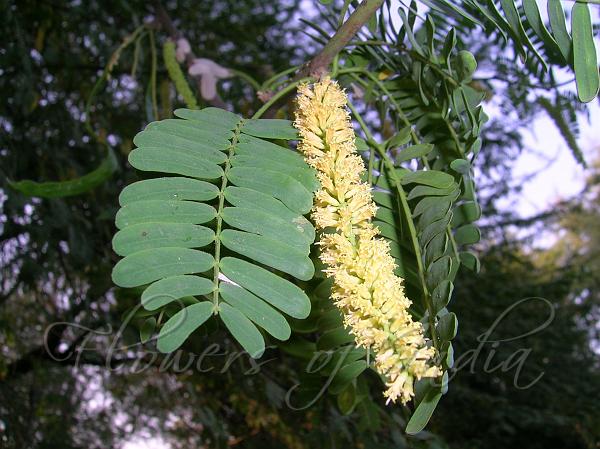
Botanical name: Neltuma juliflora Family: Mimosaceae (Touch-me-not family)
Synonyms: Prosopis juliflora, Mimosa juliflora, Algarobia juliflora
Synonyms: Prosopis juliflora, Mimosa juliflora, Algarobia juliflora
The Mesquite has been introduced in Asia and Africa and is now wide spread in
the semi-arid areas of the world. In many areas, it is considered a weed.
It is a drought resistant small tree, and has been planted in dry areas
of Delhi. It is a deciduous thorny shrub or small tree,
to 12 m tall; trunk to 1.2 m in diameter, bark thick, brown or blackish,
shallowly fissured; leaves compound, commonly many more than 9 pairs, the
leaflets are mostly 5–10 mm long, linear-oblong, glabrous, often hairy, commonly
rounded at the apex; stipular spines, if any, yellowish, often stout; flowers
perfect, greenish-yellow, sweet-scented, spikelike; corolla deeply lobate.
Pods several-seeded, strongly compressed when young, thick at maturity, more
or less constricted between the seeds, 10-25 cm long, brown or yellowish,
10–30-seeded. Mesquite pods are among the earliest known foods of prehistoric
man in the new world. Today flour products made from the pods are still
popular, although only sporadically prepared, mostly by Amerindians. Pods are
made into gruels, sometimes fermented to make a mesquite wine.
| Identification credit: Shaista Ahmad, Vaibhav D Lohot | Photographed in Lodhi Garden, New Delhi |
• Is this flower misidentified? If yes,