
| Amar Bel |

|
 |

|
| File size | 668522 |
| Original date | 8/15/06 3:41 PM |
| Resolution | 2048 x 1536 |
| Flash | Flash did not fire, auto |
| Focal length | 8.0mm |
| Exposure time | 1/44s |
| Aperture | 3.2 |
| Focus Distance | |
| Metering Mode | Partial |
| Camera make | NIKON |
| Camera model | E3700 |
| Sensor type |
 |
 ative ative |
 |
Photo: Thingnam Girija |
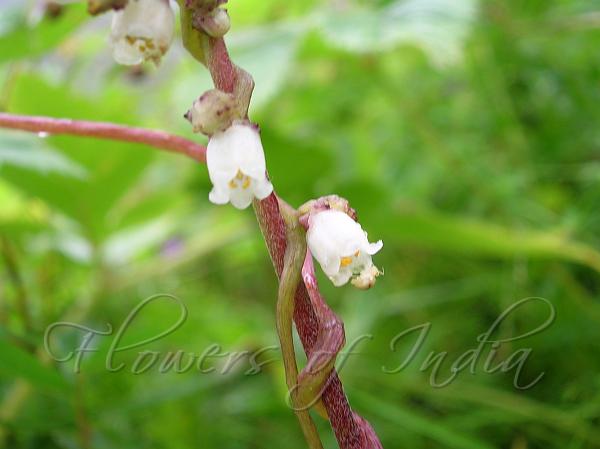
Botanical name: Cuscuta reflexa Family: Convolvulaceae (Morning glory family)
Amar bel (meaning, immortal vine) is an unusual parasitic vine related to
the Morning glory family. It grows in a prolific manner over host
plants ( or other support ) with inter-twined stems, giving it a common
name of Devils Hair. The plant is leafless and rootless. Initially the starter
plant would have
had some roots. Within a few days of germination, the plant, which is
touch sensitive, finds a host or dies. After establishing itself on a
host body, it draws nutrition from the host as a stem parasite and the
roots wither away. The twining stem develops Haustoria which are root
like and penetrate the host stem to draw water and nourishment. The
flowers are small , white, having a perfect bell shape and a fleshy
calyx, attached directly to the stem nodes.
Dodder plant is a voracious and destructive vine which usually will
overgrow and kill the host. It also is a cause of transmission of
different virus diseases such as Citrus mosaic and Purple Blotch to field
crops and trees. Its seeds can remain dormant for five years and control
of Dodder is an important issue for crops and forests.
Medicinal uses: In the villages of India the juice of Amar Bel is
used for the treatment
of jaundice, its warm paste is used to treat rheumatism and paste
of whole plant is used for the treatment of headache. Amar Bel
is used in the treatment of urination disorders, muscle pain
and cough and also used as blood purifier. Seeds of Cuscuta
reflexahave carminative and anthelmintic properties
and used to treat bilious disorder.
In the villages of India the juice of Amar Bel is
used for the treatment
of jaundice, its warm paste is used to treat rheumatism and paste
of whole plant is used for the treatment of headache. Amar Bel
is used in the treatment of urination disorders, muscle pain
and cough and also used as blood purifier. Seeds of Cuscuta
reflexahave carminative and anthelmintic properties
and used to treat bilious disorder.
Medicinal uses:
In the villages of India the juice of Amar Bel is
used for the treatment
of jaundice, its warm paste is used to treat rheumatism and paste
of whole plant is used for the treatment of headache. Amar Bel
is used in the treatment of urination disorders, muscle pain
and cough and also used as blood purifier. Seeds of Cuscuta
reflexahave carminative and anthelmintic properties
and used to treat bilious disorder.
| Identification credit: Akhila Sinha | Photographed in Valley of Flowers, Uttarakhand. |
• Is this flower misidentified? If yes,