
| Apple Mangrove |

|
 |

|


| File size | 565126 |
| Original date | 5/1/07 5:08 PM |
| Resolution | 0 x 0 |
| Flash | Flash did not fire |
| Focal length | 105.0mm |
| Exposure time | 1/500s |
| Aperture | 5.6 |
| Focus Distance | |
| Metering Mode | Multi-segment |
| Camera make | NIKON CORPORATION |
| Camera model | NIKON D80 |
| Sensor type | OneChipColorArea |
 |
 ative ative |
 |
 |
Photo: |
Botanical name: Sonneratia caseolaris Family: Lythraceae (Crape Myrtle family)
Synonyms: Sonneratia obovata, Sonneratia ovalis
Synonyms: Sonneratia obovata, Sonneratia ovalis
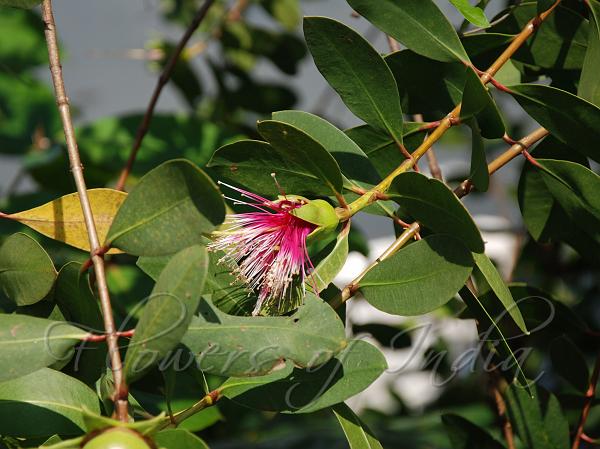
Apple mangrove is a small evergree tree, upto 8 m
tall. Branches are horizontal, twig slender. Leaves are about 7 cm
long, rounded and opposite each other on the branches. The tips of the
leaves are slightly turned under. Sonneratia alba has white
flowers while Sonneratia caseolaris has red flowers. Sepal tube
is green with 6 valvular lobes. There are 6 red petals, which are
overshadowed by long showy, numerous stamens, which are white, but
reddish at the base. Flowers only open for one night and have an
offensive smell. The fruit is large, about 4 cm across, green, leathery
berries with a star-shaped base. When ripe, the fruits are eaten raw or
cooked. Apple Mangrove is found in Indo-Malesia and Australia. In India
it is found in Western Ghats.
Medicinal uses: Fermented fruit juice is said
to be useful in arresting haemorrhage. The wall of an old fruit is
given as a vermifuge. The juice of half-ripe fruit is used to treat
coughs. The juice of the flowers enters into a compound for treating
blood in the urine.
Fermented fruit juice is said
to be useful in arresting haemorrhage. The wall of an old fruit is
given as a vermifuge. The juice of half-ripe fruit is used to treat
coughs. The juice of the flowers enters into a compound for treating
blood in the urine.
Medicinal uses:
Fermented fruit juice is said
to be useful in arresting haemorrhage. The wall of an old fruit is
given as a vermifuge. The juice of half-ripe fruit is used to treat
coughs. The juice of the flowers enters into a compound for treating
blood in the urine. | Identification credit: Asokan Mash | Photographed in Kollam,Kerala. |
• Is this flower misidentified? If yes,