
| Arhar |

|
 |

|


| File size | 1103225 |
| Original date | 12/30/07 10:09 AM |
| Resolution | 2048 x 1360 |
| Flash | Flash did not fire |
| Focal length | 6.3mm |
| Exposure time | 1/50s |
| Aperture | 3.8 |
| Focus Distance | |
| Metering Mode | Spot |
| Camera make | SONY |
| Camera model | DSC-P52 |
| Sensor type |
 |
 ative ative |
 |
 |
Photo: |
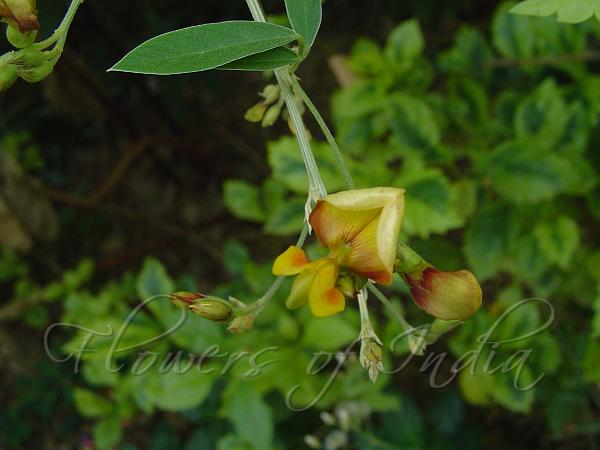
Botanical name: Cajanus cajan Family: Fabaceae (Pea family)
Synonyms: Cajanus flavus, Cajanus bicolor, Cajan inodorum
Synonyms: Cajanus flavus, Cajanus bicolor, Cajan inodorum
Arhar is the most common pulse eaten all over
India. The cultivation of Arhar goes back at least 3000 years. The
centre of origin is most likely Asia, from where it travelled to East
Africa and by means of the slave trade to the American continent. The
Arhar plant is an erect annual or short-lived perennial reaching a
height of 3-10 feet. Because the coarse bush is deeply rooted, it has
wide adaptability and grows well on semiarid land. It has slender,
pointed trifoliate leaves and yellow or yellow and red flowers. Pods
are similar to English peas, green and pointed with a bit of reddish
mottling. Several pods are produced in clusters on an upright stem.
| Identification credit: Prashant Awale | Photographed in Mumbai, Tripura & Arunachal Pradesh. |
• Is this flower misidentified? If yes,