
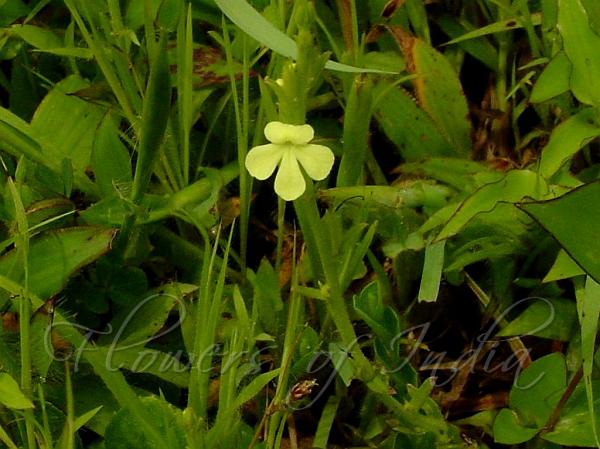
| Asiatic Witchweed |

|
 |

|


| File size | 145818 |
| Original date | 10/6/08 11:59 AM |
| Resolution | 2048 x 1536 |
| Flash | Flash did not fire |
| Focal length | 6.3mm |
| Exposure time | 1/800s |
| Aperture | 8.0 |
| Focus Distance | |
| Metering Mode | Spot |
| Camera make | SONY |
| Camera model | DSC-P52 |
| Sensor type |
 |
 ative ative |
 |
 |
Photo: |
Botanical name: Striga lutea Family: Orobanchaceae (Broomrape family)
Synonyms: Striga asiatica var. lutea, Striga phoenicea, Striga hirsuta
Synonyms: Striga asiatica var. lutea, Striga phoenicea, Striga hirsuta
Asiatic Witchweed is a coarse annual herb, growing to 10-20 cm tall. Stems
are erect, rarely branched. Leaf are small, linear to narrowly
lanceshaped, 5-20 mm long, 1-4 mm wide, sometimes reduced to scales.
Flowers arise singly or in a spike in leaf axils. Sepal cup is 4-8 mm,
10-ribbed. Sepals are 5, as long as tube. Flowers are yellow,
with a 0.8-1.5 cm long tube, and 2-lipped. Upper lip
is 2-lobed. Capsule is ovoid, enveloped in surviving sepals. This species
is harmful to crops, particularly to sugar cane. Asiatic Witchweed is
native to Tropical & Subtropical Asia to NW Pacific, including the
Himalayas and Western Ghats. Flowering: September-October.
Medicinal uses: The whole plant is used for treating intestinal
parasites.
The whole plant is used for treating intestinal
parasites.
Medicinal uses:
The whole plant is used for treating intestinal
parasites. | Identification credit: Prashant Awale | Photographed in Khandala, Maharashtra & Goa. |
• Is this flower misidentified? If yes,