
| Baheda |

|
 |

|


| File size | 1533936 |
| Original date | 3/28/09 10:56 AM |
| Resolution | 2048 x 1536 |
| Flash | Flash did not fire, auto |
| Focal length | 82.8mm |
| Exposure time | 1/500s |
| Aperture | 5.6 |
| Focus Distance | |
| Metering Mode | Multi-segment |
| Camera make | Panasonic |
| Camera model | DMC-FZ18 |
| Sensor type | OneChipColorArea |
 |
 ative ative |
 |
 |
Photo: |
Botanical name: Terminalia bellirica Family: Combretaceae (Rangoon creeper family)
Synonyms: Myrobalanus bellirica
Synonyms: Myrobalanus bellirica
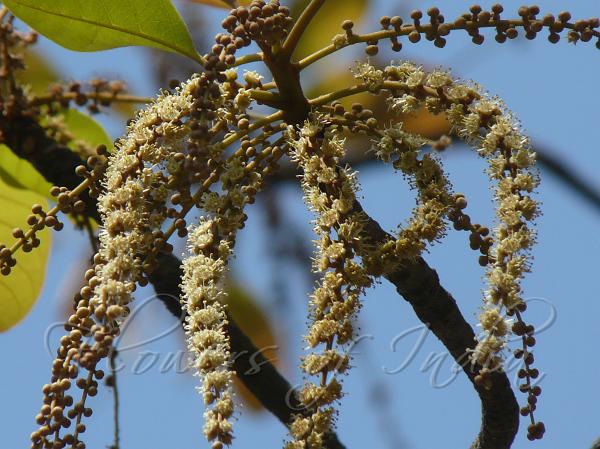
Baheda is a tall handsome tree, with characteristic bark, 12-50 m tall.
Leaves are alternately arranged or fascicled at the end of branches,
elliptic or elliptic obovate, leathery, dotted, entire. Leaf tip is narrow-
pointed or rounded. Leaves are 8-20 cm long, 7.5-15 cm wide, on stalks
2.15 cm long. Flowers arise in spikes in leaf axils, 5-15 cm long. Flowers
are greenish yellow, 5-6 mm across, stalklesse, upper flowers of the spike
are male, lower flowers are bisexual. Stamens are 3-4 mm long. Fruit is
obovoid 1.5-2.5 cm in diameter, covered with minute pale pubescence, stone
very thick, indistinctly 5 angled.
Medicinal uses: In traditional Indian Ayurvedic medicine,
Baheda is known as "Bibhitaki;" in its fruit form it is used in the
popular Indian herbal rasayana treatment triphala. This species is used by
some tribes in the Indian subcontinent for its mind-altering qualities -
they smoke dried kernels. Too much of this can cause nausea and vomiting.
In traditional Indian Ayurvedic medicine,
Baheda is known as "Bibhitaki;" in its fruit form it is used in the
popular Indian herbal rasayana treatment triphala. This species is used by
some tribes in the Indian subcontinent for its mind-altering qualities -
they smoke dried kernels. Too much of this can cause nausea and vomiting.
Medicinal uses:
In traditional Indian Ayurvedic medicine,
Baheda is known as "Bibhitaki;" in its fruit form it is used in the
popular Indian herbal rasayana treatment triphala. This species is used by
some tribes in the Indian subcontinent for its mind-altering qualities -
they smoke dried kernels. Too much of this can cause nausea and vomiting. | Identification credit: Dinesh Valke | Photographed in Maharashtra. |
• Is this flower misidentified? If yes,