
| Barringtonia |

|
 |

|


| File size | 707072 |
| Original date | 6/7/06 7:01 AM |
| Resolution | 2048 x 1536 |
| Flash | Flash fired, auto |
| Focal length | 8.0mm |
| Exposure time | 1/60s |
| Aperture | 3.2 |
| Focus Distance | |
| Metering Mode | Partial |
| Camera make | NIKON |
| Camera model | E3700 |
| Sensor type |
 |
 ative ative |
 |
 |
Photo: |
Botanical name: Barringtonia acutangula Family: Lecythidaceae (Brazilnut family)
Synonyms: Barringtonia spicata, Eugenia acutangula
Synonyms: Barringtonia spicata, Eugenia acutangula
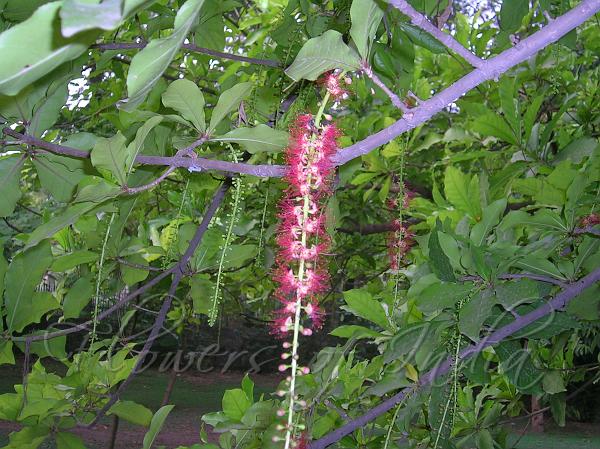
Barringtonia is an evergreen tree of moderate size, called by Sanskrit writers Hijja or Hijjala. The fruit is spoken of as Samudra-phala and Dhātriphala or ”nurse’s fruit,” and is one of the best known domestic remedies. Also called Stream Barringtonia or Itchy Tree (after a catepillar with irritant hairs that sometimes colonises the undersides of the leaves) Barringtonia is a tree 5-8 m tall with rough fissured dark grey bark. Leaves are obovate. Red flowers are produced on pendulous racemes about
20cm long. Four sided fruits are produced periodically throughout the year.
Partly deciduous in extended dry periods. This species grows on the banks of freshwater rivers, the edges of freshwater swamps and lagoons and on seasonally flooded lowland plains, commonly on heavy soils. Found in Madagascar and tropical Asia, amongst other places. Propagation is by seed. Tolerant of heavy clay soils with poor drainage, it can grow in a range of soils.
Medicinal uses: This tree has long been used for medicine,
timber and as a fish poison. In traditional medicine, when children suffer
from a cold in the chest, the seed is rubbed down on a stone with water
and applied over the sternum, and if there is much dyspnoea a few grains
with or without the juice of fresh ginger are administered internally and
seldom fail to induce vomiting and the expulsion of mucus from the air
passages. More recently it has become the focus of research for
pain-killing compounds.
This tree has long been used for medicine,
timber and as a fish poison. In traditional medicine, when children suffer
from a cold in the chest, the seed is rubbed down on a stone with water
and applied over the sternum, and if there is much dyspnoea a few grains
with or without the juice of fresh ginger are administered internally and
seldom fail to induce vomiting and the expulsion of mucus from the air
passages. More recently it has become the focus of research for
pain-killing compounds.
Medicinal uses:
This tree has long been used for medicine,
timber and as a fish poison. In traditional medicine, when children suffer
from a cold in the chest, the seed is rubbed down on a stone with water
and applied over the sternum, and if there is much dyspnoea a few grains
with or without the juice of fresh ginger are administered internally and
seldom fail to induce vomiting and the expulsion of mucus from the air
passages. More recently it has become the focus of research for
pain-killing compounds. | Identification credit: Navendu Pāgé | Photographed in Lodhi Garden, Delhi. |
• Is this flower misidentified? If yes,