
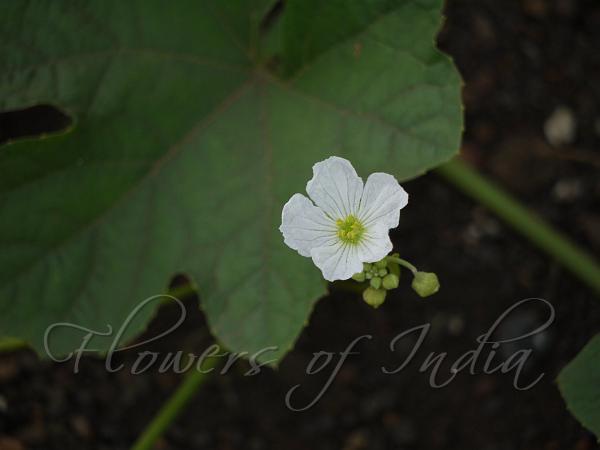
| Bitter Sponge Gourd |

|
 |

|


| File size | 165601 |
| Original date | 9/12/09 8:01 AM |
| Resolution | 2000 x 1500 |
| Flash | Flash did not fire, auto |
| Focal length | 200.0mm |
| Exposure time | 1/250s |
| Aperture | 5.6 |
| Focus Distance | |
| Metering Mode | Multi-segment |
| Camera make | Panasonic |
| Camera model | DMC-G1 |
| Sensor type | OneChipColorArea |
 |
 ative ative |
 |
 |
Photo: |
Botanical name: Luffa echinata Family: Cucurbitaceae (Pumpkin family)
Bitter Sponge Gourd is a climber with bifid bristly or smooth tendrils.
Stem is sulcate, slightly hairy to smooth. Leaves are kidney-shaped,
round, shallowly or deeply 5-lobed. Tip is rounded or rarely pointed.
Leaves are bristly on both surfaces, margin is minutely toothed. Leaf
stalk is stout, bristly, up to 12 cm long. Flowers are white, stalked,
about 2.5 cm across. Male flowers are borne in 5-12-flowered, up to 15 cm
long raceme. Sepal tube is about 5.6 mm long, hairy, sepals lance-shaped.
Petals are ovate, 1-1.2 cm long, blunt, hairy at the base. Stamens are 3,
with filaments united, 3-9 mm long, anthers entire or ± bifid. Ovary is
ovoid. Fruit is ashy, oblong, ovoid, 2-5 cm long, densely covered with 4-7
mm long bristles. Seeds are ovate, black 4-5 mm long, 3-5 mm broad and 2
mm thick. The fruit is intensely bitter and used medicinally.
Flowering: August-September.
Identification credit: Dinesh Valke
| Photographed on NH 8 near Ghodbunder, Maharashtra. |