
| Black Turmeric |

|
 |

|


| File size | 618435 |
| Original date | 5/17/20 9:56 AM |
| Resolution | 2048 x 1536 |
| Flash | Flash did not fire, auto |
| Focal length | 3.84mm |
| Exposure time | 1/108s |
| Aperture | 2.2 |
| Focus Distance | |
| Metering Mode | Center weighted average |
| Camera make | Xiaomi |
| Camera model | Redmi Y2 |
| Sensor type | OneChipColorArea |
 |
 ative ative |
 |
 |
 |
Photo: |
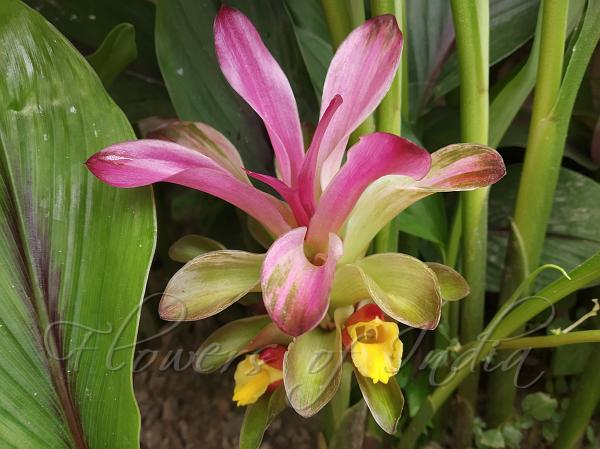
Botanical name: Curcuma caesia Family: Zingiberaceae (Ginger family)
Black Turmeric is a perennial herb with bluish-black rhizome, native to
North-East and Central India. The leaves have a deep violet-red patch
which runs through the length of the lamina. Usually, the upper side of
the leaf is rough, velvety, but this character may vary. Flowering bracts
are green with a ferruginous tinge. Flower petals may be deep pink or red
in color. The rhizome is bitter, hot taste with pungent smell. Black
Turmeric is used in Tantrik Sadhana. The dried leaves are used as a
source for fuel. Northern tribes use Black Turmeric as a talisman to keep the
evil spirits away. Presently Black Turmeric is on the verge of extinction.
Medicinal uses: Claimed to be useful in treating Piles, Leprosy,
Bronchitis, Asthma, Cancer, Epilepsy, Fever, Wounds, Impotency, Fertility,
Menstrual disorders, tooth ache, vomiting etc.
Claimed to be useful in treating Piles, Leprosy,
Bronchitis, Asthma, Cancer, Epilepsy, Fever, Wounds, Impotency, Fertility,
Menstrual disorders, tooth ache, vomiting etc.
Medicinal uses:
Claimed to be useful in treating Piles, Leprosy,
Bronchitis, Asthma, Cancer, Epilepsy, Fever, Wounds, Impotency, Fertility,
Menstrual disorders, tooth ache, vomiting etc. | Identification credit: Sulochana Thingnam | Photographed in Imphal, Manipur. |
• Is this flower misidentified? If yes,