
| Black-Honey Shrub |

|
 |

|


| File size | 765843 |
| Original date | 6/21/20 5:47 PM |
| Resolution | 4032 x 1860 |
| Flash | Flash did not fire |
| Focal length | 3.93mm |
| Exposure time | 1/112s |
| Aperture | 1.7 |
| Focus Distance | |
| Metering Mode | Spot |
| Camera make | samsung |
| Camera model | SM-A505F |
| Sensor type |
 |
 ative ative |
 |
 |
Photo: |
Botanical name: Phyllanthus reticulatus Family: Phyllanthaceae (Amla family)
Synonyms: Kirganelia reticulata, Anisonema reticulatum, Cicca reticulata, Diasperus reticulatus
Synonyms: Kirganelia reticulata, Anisonema reticulatum, Cicca reticulata, Diasperus reticulatus
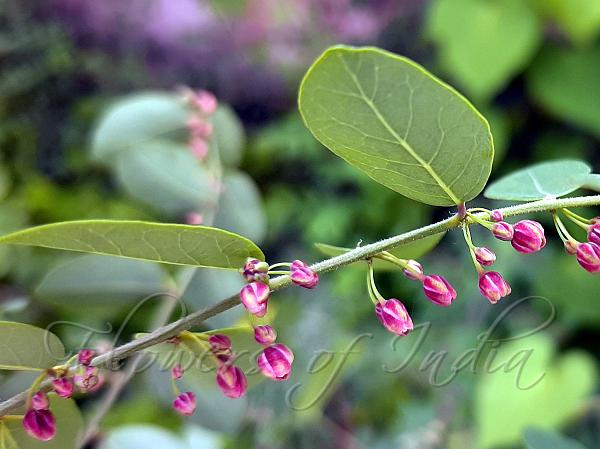
Black-Honey Shrub is usually a much-branched somewhat climbing shrub,
rarely a small tree. Leaves are ovate-oblong to elliptic, 1-5 cm long,
0.7-3 cm wide, produced on short lateral branchlets, looking like leaflets
of a compound leaf. Flowers are borne in clusters on short axillary
branchlets, small, yellowish, sexes separate on the same plant, flowering
before or with the new leaves. The flowering shoots and pedicels are
covered in short, velvety hairs. Fruit is berry-like, 4-6 mm across,
blackish when ripe. Flowering: March-July.
Medicinal uses: The leaves and roots are used as medicine for
the fractures and traumatic injury
The leaves and roots are used as medicine for
the fractures and traumatic injury
Medicinal uses:
The leaves and roots are used as medicine for
the fractures and traumatic injury | Identification credit: Stephen A | Photographed at Maharashtra. |
• Is this flower misidentified? If yes,