
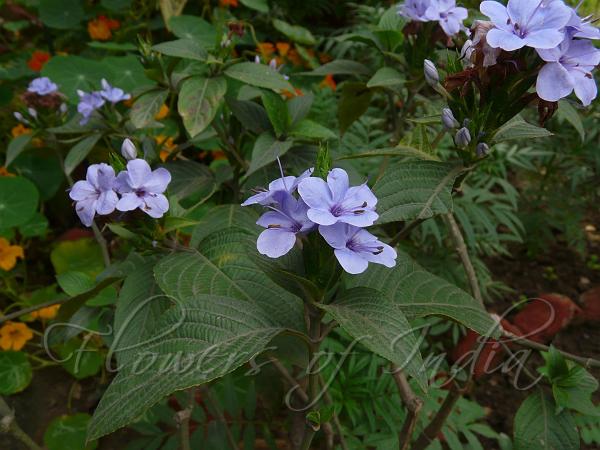
| Blue Sage |

|
 |

|


| File size | 628600 |
| Original date | 3/18/11 4:01 PM |
| Resolution | 2560 x 1920 |
| Flash | Flash did not fire, auto |
| Focal length | 4.6mm |
| Exposure time | 1/160s |
| Aperture | 4.0 |
| Focus Distance | |
| Metering Mode | Spot |
| Camera make | Panasonic |
| Camera model | DMC-FZ18 |
| Sensor type | OneChipColorArea |
 |
 ative ative |
 |
Photo: |
Botanical name: Eranthemum pulchellum Family: Acanthaceae (Acanthus family)
Synonyms: Eranthemum nervosum, Justicia nervosa, Daedalacanthus nervosus
Synonyms: Eranthemum nervosum, Justicia nervosa, Daedalacanthus nervosus
Blue Sage is a woody perennial herb or shrub.
Leaves opposite simple, stalked, usually entire, elliptic or ovate-elliptic,
10-24 x 4.5-8 cm, basally narrowed, prominently nerved, lateral nerves about
10 pairs, long pointed.
Flowers are blue, purple, violet or purplish-white at branch-ends
or in leaf-axils, in simple or branched dense spikes.
Flower tube is cylindrical, more than twice as long as or
equal patent limb lobes, overlapping. Fertile stamens are 2 with narrowly
oblong, anthers, protruding out. Sepal-cup is deeply 5-lobed,
sepals equal, valvate, almost scarious. Bracts are large, longer
than the sepal-cup, neither fringed with hairs nor spinescent, bracteoles
smaller than sepals. Blue Sage is found in the subtropical Himalaya, Punjab
to Bhutan, Burma, Indo-China, W. China, at altitudes of 200-1200 m.
Flowering: February-April.
| Identification credit: Pravin Kawale | Photographed in Delhi and Uttarakhand. |
• Is this flower misidentified? If yes,