
| Bush Grape |

|
 |

|


| File size | 2041478 |
| Original date | 12/15/07 3:33 PM |
| Resolution | 2816 x 2112 |
| Flash | Flash did not fire, auto |
| Focal length | 6.0mm |
| Exposure time | 1/60s |
| Aperture | 3.6 |
| Focus Distance | |
| Metering Mode | Multi-segment |
| Camera make | Panasonic |
| Camera model | DMC-FZ7 |
| Sensor type | OneChipColorArea |
 |
 ative ative |
 |
 |
Photo: Dinesh Valke |
Botanical name: Causonis trifolia Family: Vitaceae (Grape family)
Synonyms: Cissus trifolia, Vitis trifolia, Vitis carnosa, Cayratia trifolia
Synonyms: Cissus trifolia, Vitis trifolia, Vitis carnosa, Cayratia trifolia
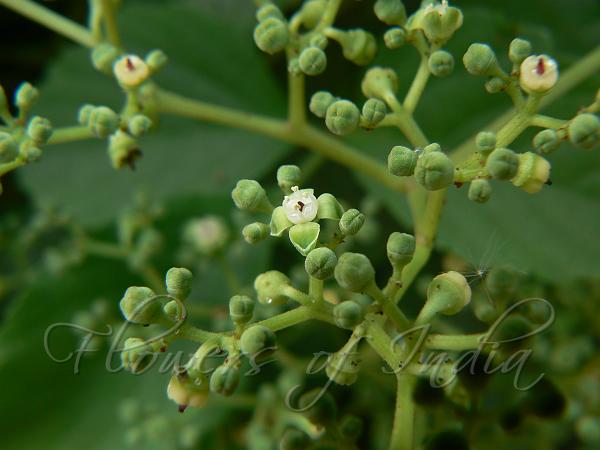
Native to India, Bush Grape is a vine that climbs by means of tendrils
which are found opposite the leaves. The leaves are trifoliolate with
petioles 2-3 cm long. The leaflets are ovate to oblong-ovate, 2-8 cm long,
1.5-5 cm wide, pointed at the tip, and coarsely toothed at the margins. The
flowers are small greenish white and borne on solitary cymes in leaf axils.
The fruit is fleshy, juicy, dark purple or black, nearly spherical and
about 1 cm in diameter. Flowering: December.
Medicinal uses: The root, ground with black pepper, is applied
to boils. The root is also used as an astringent medicine.
The root, ground with black pepper, is applied
to boils. The root is also used as an astringent medicine.
Medicinal uses:
The root, ground with black pepper, is applied
to boils. The root is also used as an astringent medicine. | Identification credit: Dinesh Valke | Photographed at Vaghbil, Thane, Maharashtra & Bijnor, UP. |
• Is this flower misidentified? If yes,