
| Ceylon Tea |

|
 |

|


| File size | 257646 |
| Original date | 10/15/07 10:57 AM |
| Resolution | 2048 x 1360 |
| Flash | Flash did not fire |
| Focal length | 6.3mm |
| Exposure time | 1/400s |
| Aperture | 8.0 |
| Focus Distance | |
| Metering Mode | Spot |
| Camera make | SONY |
| Camera model | DSC-P52 |
| Sensor type |
 |
 ative ative |
 |
 |
Photo: |
Botanical name: Elaeodendron glaucum Family: Celastraceae (Spike-thorn family)
Synonyms: Cassine glauca, Mangifera glauca, Elaeodendron paniculatum
Synonyms: Cassine glauca, Mangifera glauca, Elaeodendron paniculatum
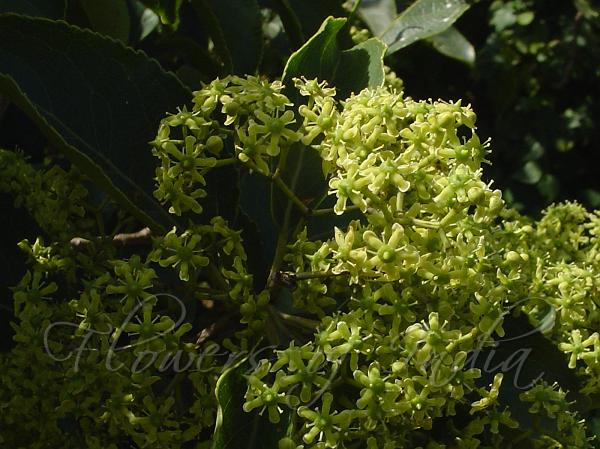
Ceylon Tea is a large evergreen tree, upto 5 meters high. The genus name Elaeodendron means, olive tree - maybe referring to the ovoid fruit. Branchlets are
reddish; bark red inside, exuding a watery sap when cut. Leaves are simple,
opposite, 3-16 x 1.5-7.5 cm, elliptic, ovate-oblong or obovate, glabrous,
dark green, shining above, glaucous beneath; petiole 0.5-1 cm long,
channelled. Inflorescence is an axillary dichotomous cyme; Flower white or
greenish yellow. Stamens four, inserted on the margin of the disk,
recurved; anthers with a bilobed connective. Stamens shorter than petals.
Disk thick and fleshy. Ovary 4-celled united with the disk; style short;
fruit green in colour, ovoid and a drupe. In the Western Ghats, it is found
in Satara, Pune, Konkan (Harishchandragad). Flowering: February-May.
| Identification credit: Prashant Awale | Photographed at Nimgiri, Maharashtra. |
• Is this flower misidentified? If yes,