
| Climbing Flower Cup |

|
 |

|


| File size | 202310 |
| Original date | |
| Resolution | 2048 x 1536 |
| Flash | Flash did not fire |
| Focal length | 6.3mm |
| Exposure time | 1/100s |
| Aperture | 3.8 |
| Focus Distance | |
| Metering Mode | Spot |
| Camera make | SONY |
| Camera model | DSC-P52 |
| Sensor type |
 |
 ative ative |
 |
 |
Photo: |
Botanical name: Floscopa scandens Family: Commelinaceae (Dayflower family)
Synonyms: Tradescantia paniculata, Commelina hispida, Aneilema hispida
Synonyms: Tradescantia paniculata, Commelina hispida, Aneilema hispida
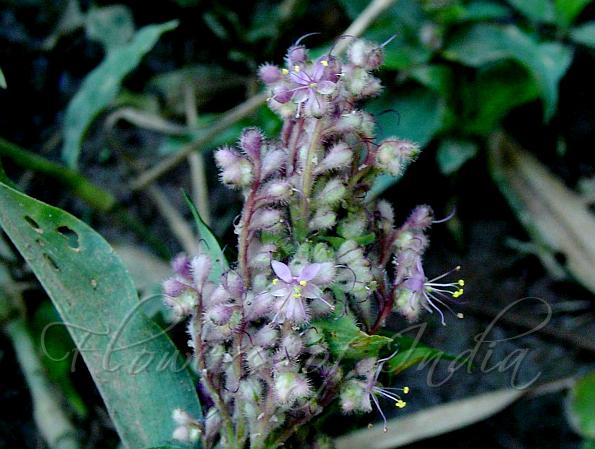
Creeping Flower Cup is a small trailing herb.
Flowers are many, 3-5 mm across, regular, bisexual; sepals 3 x 2 mm,
ovate, velvet-hairy; petals 3 x 2 mm, obovate, hairless, rose coloured;
stamens 6, filaments free, hairless; anthers small, blunt, with broad
connective. Flowers arise in broomlike hairy panicles up to 8 x 4 cm, in leaf
axils or at the end of branches. Panicles are shortly stalked, pyramidal,
with long, erect or ascending, many-flowered branches.
The stems are stout, erect,
and creeping below, 20-70 cm long. Plants are glandular velvety throughout
with multicellular hairs, or hairy only on leaf sheaths and
inflorescences, sometimes sheaths hairy only on 1 side. The leaves are
elliptic to lance-shaped, 3-9.5 cm long, 1-2 cm wide, stalkless or short-
stalked. The capsules are 2-3 mm long, circular or ellipsoid, and
compressed. The seeds are glaucous. Climbing Flower Cup is found in the
Himalayas at altitudes of 800-1800 m. It is also found in other parts of
India. Flowering: July-November.
Medicinal uses: This plant is used in folk medicine, in treating broken bones.
Extract of the stem is used for sore eyes.
This plant is used in folk medicine, in treating broken bones.
Extract of the stem is used for sore eyes.
Medicinal uses:
This plant is used in folk medicine, in treating broken bones.
Extract of the stem is used for sore eyes. | Identification credit: Prashant Awale | Photographed in Mizoram & Manipur. |
• Is this flower misidentified? If yes,