Elephant Creeper is a vigorous vine native to India, introduced
world-wide. It has large, leathery heart-shaped leaves, which are white on
the underside due to hairs. It is called elephant creeper because of the
large leaves which look like elephant ears. Leaf blades are 15-25 cm long,
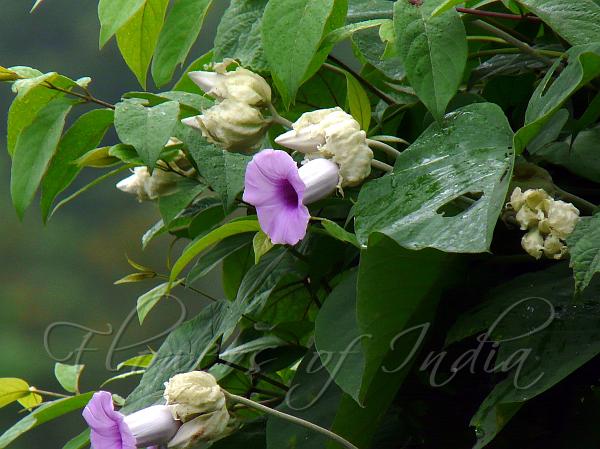
and 13-20 cm wide, heart-shaped. Trumpet-shaped flowers are borne in
cymes, on long, white-velvety stalks. Sepals are 1.3-1.5 cm long, velvety
like the leaves. Flower-stalks are up to 15 cm long. Flowers are 5-7.5 cm
long, with a short tube and bell-shaped limb, lavender to pink, the throat
being of a darker shade. The flowers are followed by hard, woody capsules,
which when they ripen break open to resemble miniature roses. The toxic
seeds should not be eaten as they contain alkaloids.
Flowering: July-December, March-April.
Identification credit: Dinesh Valke
Photographed at Ghodbunder Road, Thane, Maharashtra & Sundar Nursery, Delhi.
• Is this flower misidentified?
If yes,
Your name: Your email: Your comments
The flower labeled Elephant Creeper is ...






 ative
ative
