
| Flame of the Forest |

|
 |

|


| File size | 1994354 |
| Original date | 3/20/08 5:39 PM |
| Resolution | 2592 x 1944 |
| Flash | Flash did not fire, auto |
| Focal length | 5.8mm |
| Exposure time | 1/60s |
| Aperture | 2.8 |
| Focus Distance | |
| Metering Mode | Spot |
| Camera make | SONY |
| Camera model | DSC-S650 |
| Sensor type |
 |
 ative ative |
 |
 |
Photo: |
Botanical name: Butea monosperma Family: Fabaceae (Pea family)
Synonyms: Butea frondosa, Butea braamania, Plaso monosperma
Synonyms: Butea frondosa, Butea braamania, Plaso monosperma
 Native to India, Flame of the Forest is a medium
sized tree, growing 20-40 feet high, and the trunk is usually crooked and twisted with irregular
branches and rough, grey bark. The leaves are pinnate, with an 8-16 cm
petiole and three leaflets, each leaflet 10-20 cm long. The hindi phrase
ढाक के तीन पात ("Dhaak ke teen paat") comes from the prominent three leaflets
of this tree. It is seen in all its ugliness in December and January when most of the leaves fall: but from January to March it
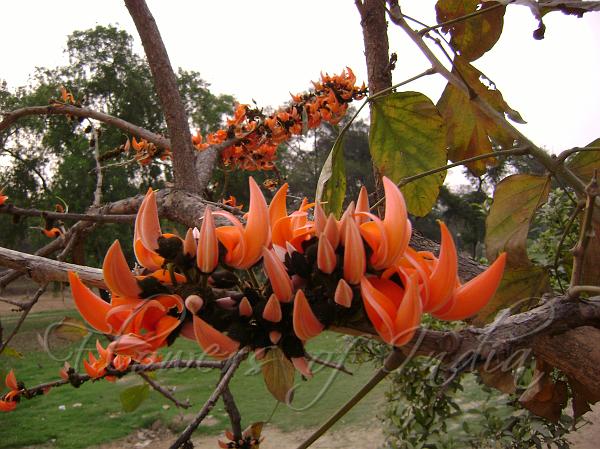
truly becomes a tree of flame, a riot of orange and vermilion flowers
covering the entire crown. These flowers, which are scentless, are
massed along the ends of the stalks--dark velvety green like the cup-shaped
calices--and the brilliance of the stiff, bright flowers is shown off
to perfection by this deep, contrasting colour. Each flower consists of
five petals comprising one standard, two smaller wings and a very
curved beak-shaped keel. It is this keel which gives it the name of Parrot
Tree. In olden days, the flowers of Tesu were used to make color for
the festival of Holi. In Manipur, there is an interesting cultural use of the wood of this
tree with beautiful flowers - when a member of the
Native to India, Flame of the Forest is a medium
sized tree, growing 20-40 feet high, and the trunk is usually crooked and twisted with irregular
branches and rough, grey bark. The leaves are pinnate, with an 8-16 cm
petiole and three leaflets, each leaflet 10-20 cm long. The hindi phrase
ढाक के तीन पात ("Dhaak ke teen paat") comes from the prominent three leaflets
of this tree. It is seen in all its ugliness in December and January when most of the leaves fall: but from January to March it
truly becomes a tree of flame, a riot of orange and vermilion flowers
covering the entire crown. These flowers, which are scentless, are
massed along the ends of the stalks--dark velvety green like the cup-shaped
calices--and the brilliance of the stiff, bright flowers is shown off
to perfection by this deep, contrasting colour. Each flower consists of
five petals comprising one standard, two smaller wings and a very
curved beak-shaped keel. It is this keel which gives it the name of Parrot
Tree. In olden days, the flowers of Tesu were used to make color for
the festival of Holi. In Manipur, there is an interesting cultural use of the wood of this
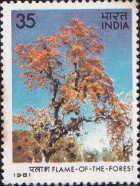
tree with beautiful flowers - when a member of the A postal stamp was issued by the Indian Postal Department to commemorate this flower.
| Identification credit: R.K. Nimai Singh | Photographed in Delhi & Maharashtra. |
• Is this flower misidentified? If yes,