
| Flax |

|
 |

|


| File size | 94535 |
| Original date | 2/20/13 8:44 AM |
| Resolution | 800 x 600 |
| Flash | Flash did not fire, auto |
| Focal length | 9.1mm |
| Exposure time | 1/322s |
| Aperture | 4.4 |
| Focus Distance | |
| Metering Mode | Multi-segment |
| Camera make | NIKON |
| Camera model | COOLPIX S550 |
| Sensor type |
 |
 ntroduced ntroduced |
 |
 |
Photo: |
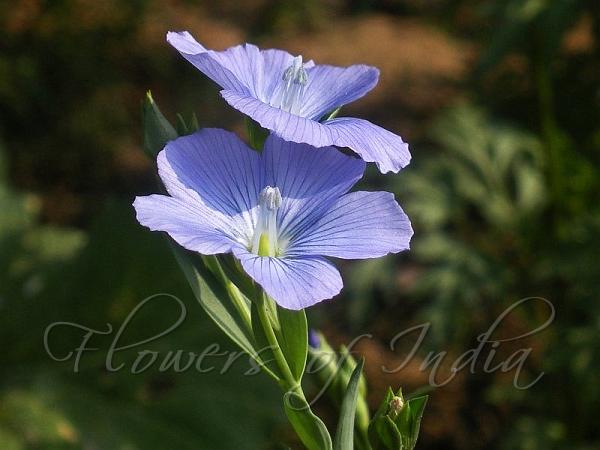
Botanical name: Linum usitatissimum Family: Linaceae (Linseed family)
Flax is a cool temperate annual herb with erect, slender stems, 80-120 cm
tall. A cultivated plant in closely spaced field conditions it has little
branching except at the apex. Leaves are alternate, lance-like and
greyish-green with 3 veins. Flowers have five, pale blue petals in a
cluster. The sepals are lance-like and nearly as long as the pointed fruit.
The fruit are spherical capsules. The seeds are oval, somewhat flattened,
4-6mm long and are pale to dark brown and shiny. Flax is native to the
region extending from the eastern Mediterranean to India. It was
extensively cultivated in ancient Egypt. Flax is grown both for its seed
and for its fibres. Interestingly, the species name usitatissimum
means, most useful. Various parts of the plant have been used to make
fabric, dye, paper, medicines, fishing nets and soap. The oil extracted
from the seed is used in cooking, as linseed oil or flaxseed oil.
It is also grown as
an ornamental plant in gardens, as flax is one of the few plant species
capable of producing truly blue flowers (most "blue" flowers are really
shades of purple), although not all flax varieties produce blue flowers.
In Durga Puja, five flowers are offered to goddes Durga, red China Rose,
Red Oleander, Lotus, Aparajita and Atasi (Flax). Flax is native to Turkey to Iran., widely cultivated elsewhere.
Medicinal uses: In Ayurveda, Flax is used internally in habitual
constipation, functional disorders of the colon resulting from the misuse of
laxatives and irritable colon, as a demulcent preparation in gastritis and
enteritis. Externally, the powdered seeds or the press-cake are used as an
emollient, in poultices for boils, carbuncles and other skin afflictions.
Used in Soothing Body Lotion for dry skin.
In Ayurveda, Flax is used internally in habitual
constipation, functional disorders of the colon resulting from the misuse of
laxatives and irritable colon, as a demulcent preparation in gastritis and
enteritis. Externally, the powdered seeds or the press-cake are used as an
emollient, in poultices for boils, carbuncles and other skin afflictions.
Used in Soothing Body Lotion for dry skin.
Medicinal uses:
In Ayurveda, Flax is used internally in habitual
constipation, functional disorders of the colon resulting from the misuse of
laxatives and irritable colon, as a demulcent preparation in gastritis and
enteritis. Externally, the powdered seeds or the press-cake are used as an
emollient, in poultices for boils, carbuncles and other skin afflictions.
Used in Soothing Body Lotion for dry skin. | Identification credit: Tabish | Photographed in Hooghly, West Bengal. |
• Is this flower misidentified? If yes,