
| Forest Champa |

|
 |

|


| File size | 71659 |
| Original date | 11/16/08 10:12 AM |
| Resolution | 640 x 480 |
| Flash | Flash did not fire, auto |
| Focal length | 19.2mm |
| Exposure time | 1/164s |
| Aperture | 5.3 |
| Focus Distance | |
| Metering Mode | Multi-segment |
| Camera make | NIKON |
| Camera model | COOLPIX L3 |
| Sensor type |
 |
 ative ative |
 |
Photo: Narendra Joshi |
Botanical name: Spermadictyon suaveolens Family: Rubiaceae (Coffee family)
Synonyms: Hamiltonia suaveolens, Hamiltonia mysorensis
Synonyms: Hamiltonia suaveolens, Hamiltonia mysorensis
Forest Champa is a branched shrub, growing up to 1-2
m tall. The species name suaveolens means sweet-scented, and refers to
the fragrant flowers.
All vegetative parts stink when bruised. Oppositely arranged
elliptic-lancelike leaves, 10-20 cm, are finely velvety. Leaf stalks
are 1-2 cm long.
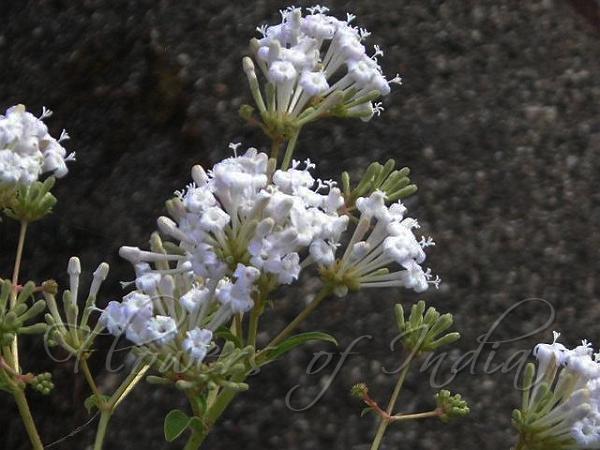
Flowers occur in many-flowered spherical heads, arrange in panicles at the end of branches. The spherical heads are 5-10 cm across.
Flowers are fragrant, in bunches of 5 or more. Sepals are small, very
narrow, and tapering. Flowers are white with a
relatively long tube and short, oblong petals. The tube is slender,
funnel-shaped, up to 1.5 cm long, with 4-5 short petals, spreading up to 8 mm.
Stamens remain inside the
flower throat. Style with 5-lobed stigma protrudes out of the flower. Fruit
is capsule-like, crowned by the leftover sepals. In China it is grown for
its showy, fragrant flowers. Only seen wild in India. This flower is seen
in Western Ghats and Himalayas, from Pakistan to SE Tibet, at altitudes of
700-2300 m. Flowering: October-March.
| Identification credit: Tabish | Photographed in Maharashtra. |
• Is this flower misidentified? If yes,