
| Great Morinda |

|
 |

|


 |
 ative ative |
 |
 |
Photo: |
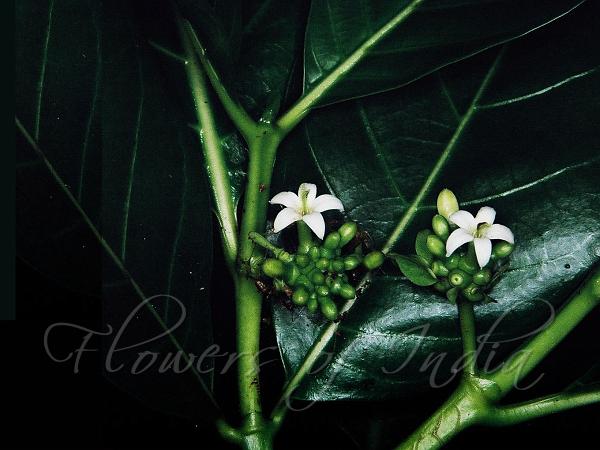
Botanical name: Morinda citrifolia Family: Rubiaceae (coffee family)
Great morinda is a shrub or small tree
that grows well on sandy or rocky shores. Apart
from saline conditions, the plant also can withstand drought and grows in
secondary soils. It can grow up to 9 m tall, and has large, simple, dark
green, shiny and deeply veined leaves. The plant flowers and fruits all year
round. The flowers are small and white. The fruit is a multiple fruit that has
a pungent odor when ripening, and is hence also known as cheese fruit or even
vomit fruit. It is oval and reaches 4-7 cm in size. At first green, the fruit
turns yellow then almost white as it ripens. It contains many seeds. It is
sometimes called starvation fruit. Despite its strong smell and bitter taste,
the fruit is nevertheless eaten as a famine food. Great morinda is native to
Tropical & Subtropical Asia, including India.
Medicinal uses: Scientific studies have investigated noni's effect
on the growth of cancerous tissue. One such study found that noni inhibited
and reduced growth of the capillary vessels sprouting from human breast tumor
explants and, at increased concentrations, the noni caused existing vessels in tumors to rapidly degenerate.
Scientific studies have investigated noni's effect
on the growth of cancerous tissue. One such study found that noni inhibited
and reduced growth of the capillary vessels sprouting from human breast tumor
explants and, at increased concentrations, the noni caused existing vessels in tumors to rapidly degenerate.
Medicinal uses:
Scientific studies have investigated noni's effect
on the growth of cancerous tissue. One such study found that noni inhibited
and reduced growth of the capillary vessels sprouting from human breast tumor
explants and, at increased concentrations, the noni caused existing vessels in tumors to rapidly degenerate.| Identification credit: Navendu Pāgé | Photographed in Maharashtra. |
• Is this flower misidentified? If yes,