
| Himalayan Cypress |

|
 |

|


| File size | 1312542 |
| Original date | 2/3/21 4:56 PM |
| Resolution | 3891 x 2733 |
| Flash | Flash did not fire |
| Focal length | 40.0mm |
| Exposure time | 1/80s |
| Aperture | 13.0 |
| Focus Distance | |
| Metering Mode | Center weighted average |
| Camera make | NIKON CORPORATION |
| Camera model | NIKON D5300 |
| Sensor type | OneChipColorArea |
 |
 ative ative |
 |
 |
 |
Photo: |
Botanical name: Cupressus torulosa Family: Cupressaceae (Cypress family)
Synonyms: Cupressus pakistanensis, Cupressus nepalensis, Cupressus karnaliensis
Synonyms: Cupressus pakistanensis, Cupressus nepalensis, Cupressus karnaliensis
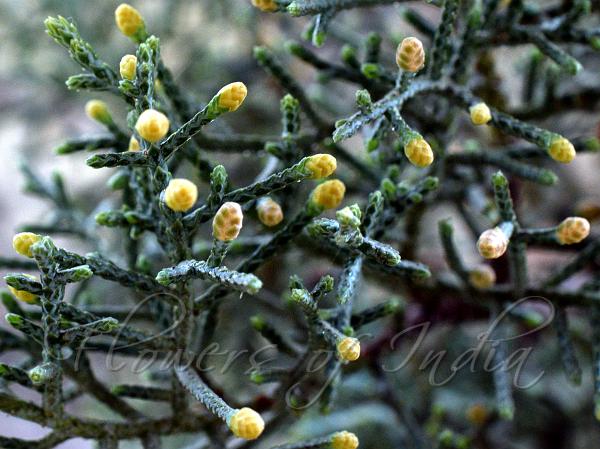
Himalayan Cypress is a tree up to 45 m tall, with
trunk up to 3.5 m d.b.h.. Branchlets are loosely or densely arranged,
round, ultimate ones drooping or irregularly spreading, slender, 1-1.4
mm in diam. Leaves are closely arranged, scalelike, 1-1.8 mm, flat or
slightly gibbous and with a rounded, sometimes inprominent central
lower gland, tip usually slightly blunt. Pollen cones are 3-6 mm;
microsporophylls 14-18. Seed cones are dark grayish brown when ripe,
not glaucous, broadly ovoid or nearly spherical, 1.2-2 x 1-1.8 cm; cone
scales 10-12, each fertile scale with numerous seeds; bracts with a
prominent umbo or mucro at tip. Seeds are ovate-oblong, flattened, 3-5
mm. Himalayan Cypress is found in mountains at altitudes of 1800-2800
m, in the Himalayas, from Kashmir to Nepal and Bhutan.
| Identification credit: Sunit Singh | Photographed at HNB University, Srinagar, Uttarakhand. |
• Is this flower misidentified? If yes,