
| Himalayan Marsh Orchid |

|
 |

|


| File size | 2323943 |
| Original date | 6/23/09 2:13 PM |
| Resolution | 2560 x 1920 |
| Flash | Flash did not fire, auto |
| Focal length | 4.6mm |
| Exposure time | 1/200s |
| Aperture | 5.6 |
| Focus Distance | |
| Metering Mode | Multi-segment |
| Camera make | Panasonic |
| Camera model | DMC-FZ18 |
| Sensor type | OneChipColorArea |
 |
 ative ative |
 |
 |
 |
Photo: |
Botanical name: Dactylorhiza hatagirea Family: Orchidaceae (Orchid family)
Synonyms: Orchis latifolia var. indica
Synonyms: Orchis latifolia var. indica
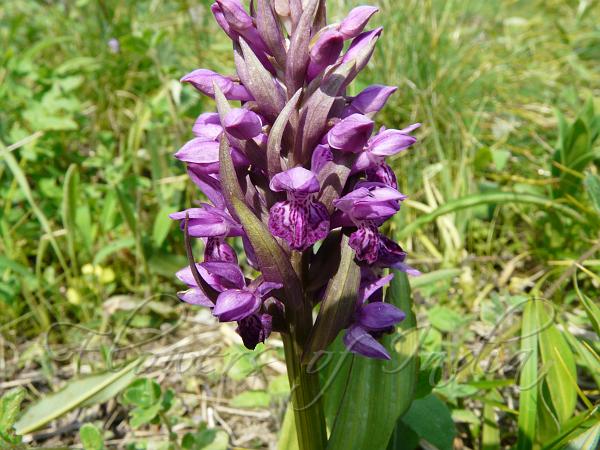
Himalayan Marsh Orchid is a medicinal herb which is now
considered critically
endangered. It is a perennial herb with erect, leafy, stout and hollow
stem. Leaves are oblong-lance-shaped, with sheathing base. Pink purple flowers
are borne in an upright spike. Flowers are purple and the bracts green,
narrowly lance-shaped, lower longer than the flowers, upper slightly
shorter. Flowers are about 1.8 cm long, including the curved spur. Sepals
and petals are nearly equal. Three of them form a hood, and the two side
sepals spread outwards. The lip is rounded and shallowly 3-lobed, spotted
dark purple. Marsh Orchis is found in shrubberies, open slopes and
marshes, in the Himalayas, from Pakistan to SE Tibet, at altitudes of
2800-4000 m. Flowering: June-July.
Roots are tuberous, divided into 2 or 3 lobes.
Medicinal uses: The tuber yields salap and is reputed as
expectorant, aphrobisiac and as nervine tonic. Locally it is used as a
nervine tonic and aphrodisiac.
The tuber yields salap and is reputed as
expectorant, aphrobisiac and as nervine tonic. Locally it is used as a
nervine tonic and aphrodisiac.
Medicinal uses:
The tuber yields salap and is reputed as
expectorant, aphrobisiac and as nervine tonic. Locally it is used as a
nervine tonic and aphrodisiac. | Identification credit: Tabish | Photographed in Valley of Flowers, Uttarakhand. |
• Is this flower misidentified? If yes,