
| Himalayan Milk Vetch |

|
 |

|


| File size | 79368 |
| Original date | 7/26/08 1:56 PM |
| Resolution | 521 x 768 |
| Flash | Flash did not fire, auto |
| Focal length | 6.0mm |
| Exposure time | 1/125s |
| Aperture | 4.0 |
| Focus Distance | |
| Metering Mode | Center weighted average |
| Camera make | Canon |
| Camera model | Canon PowerShot S5 IS |
| Sensor type | OneChipColorArea |
 |
 ative ative |
 |
 |
Photo: |
Botanical name: Astragalus himalayanus Family: Fabaceae (Pea family)
Synonyms: Astragalus carinalis, Astragalus maddenianus
Synonyms: Astragalus carinalis, Astragalus maddenianus
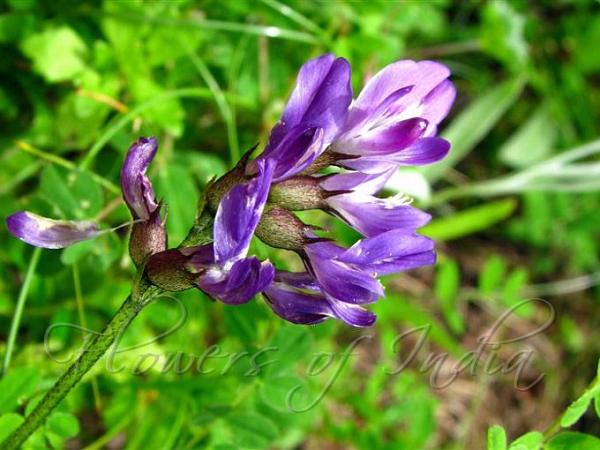
Himalayan Milk Vetch is an erect or spreading
perennial herb, with rather dense rounded clusters of lilac or mauve
flowers, borne on stalks usually longer than the subtending leaves.
Flowers are often many in each cluster, each 1-1.5 cm long. Sepal tube
is about 5 mm, with black and white hairs. Leaves are usually 3-5 cm
long, with many leaflets 4-10 mm, oblong blunt or notched, pale green
with white hairs. Stems are 1-2 ft, with adpressed hairs. Pods are
0.9-1.3 cm, with black hairs. Himalayan Milk Vetch is found in the
Himalayas, from Kashmir to E. Nepal, at altitudes of 2400-4500 m. It is
common in Kashmir. Flowering: June-September.
| Identification credit: Tabish | Photographed in Valley of Flowers, Uttarakhand. |
• Is this flower misidentified? If yes,