
| Himalayan Monkshood |

|
 |

|


| File size | 335358 |
| Original date | 8/15/06 11:22 AM |
| Resolution | 2048 x 1536 |
| Flash | Flash did not fire, auto |
| Focal length | 8.0mm |
| Exposure time | 1/203s |
| Aperture | 3.2 |
| Focus Distance | |
| Metering Mode | Partial |
| Camera make | NIKON |
| Camera model | E3700 |
| Sensor type |
 |
 ative ative |
 |
 |
Photo: Thingnam Girija |
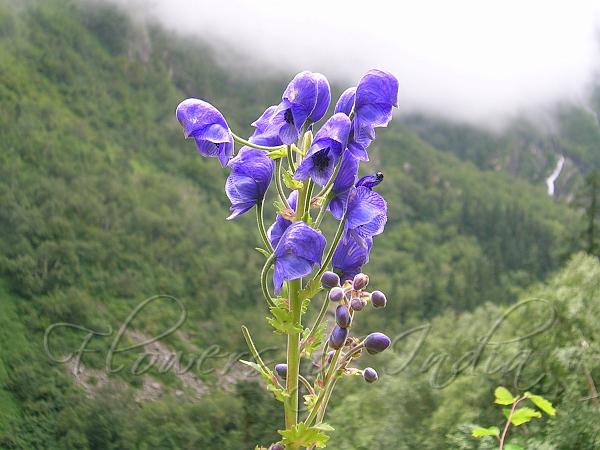
Botanical name: Aconitum heterophyllum var. bracteatum Family: Ranunculaceae (Buttercup family)
Himalayan Monkshood is a perennial that grows up to 1-4 ft tall, but
often stunted at high altitudes. It can be identified by its rather large
deep- or bright-blue flowers, and it's coarsely
toothed but otherwise entire upper leaves.
It is has a close cousin
Greenish Himalayan Monkshood which is different in having
greenish-violet flowers.
Flowers are 2.5-3 cm, usually in lax spike-like cluster with very variable
bracts which are either small linear, small ovate, or large ovate and
enclosing the lower part of the flower and fruit. The hood is rounded,
broader than long. Leaves are ovate-heart-shaped to rounded, usually 4-8 cm,
the upper clasping the stem. All leaves have large rounded teeth. Lowest
leaves are deeply lobed and long-stalked. Seedpods are 5, 16-18 mm,
shortly hairy, erect. Himalayan Monkshood is found in the Himalayas,
from Pakistan to C Nepal, at altitudes of 2400-4000 m.
Medicinal uses: Himalayan Monkshood is used extensively in Ayruvadic medicine. The
crushed eaves, mixed with saindhav are applied locally. The seeds
crushed in honey are applied locally on throat, in tonsillitis. Nasal
insufflations of roots is beneficial in headache. Seed and root are
used in ascites. Seeds are laxative. The seeds are diuretic, the root
decoction reduces burning of urinary tract. It increases volume of urine.
Himalayan Monkshood is used extensively in Ayruvadic medicine. The
crushed eaves, mixed with saindhav are applied locally. The seeds
crushed in honey are applied locally on throat, in tonsillitis. Nasal
insufflations of roots is beneficial in headache. Seed and root are
used in ascites. Seeds are laxative. The seeds are diuretic, the root
decoction reduces burning of urinary tract. It increases volume of urine.
Medicinal uses:
Himalayan Monkshood is used extensively in Ayruvadic medicine. The
crushed eaves, mixed with saindhav are applied locally. The seeds
crushed in honey are applied locally on throat, in tonsillitis. Nasal
insufflations of roots is beneficial in headache. Seed and root are
used in ascites. Seeds are laxative. The seeds are diuretic, the root
decoction reduces burning of urinary tract. It increases volume of urine.
| Identification credit: Tabish | Photographed in Valley of Flowers, Uttarakhand. |
• Is this flower misidentified? If yes,