
| Himalayan Sapria |

|
 |

|


| File size | 1050259 |
| Original date | 10/21/18 2:24 PM |
| Resolution | 2048 x 1536 |
| Flash | Flash did not fire, auto |
| Focal length | 4.225mm |
| Exposure time | 1/50s |
| Aperture | 2.0 |
| Focus Distance | |
| Metering Mode | Center weighted average |
| Camera make | Xiaomi |
| Camera model | Redmi 3S |
| Sensor type | OneChipColorArea |
 |
 ative ative |
 |
 |
Photo: |
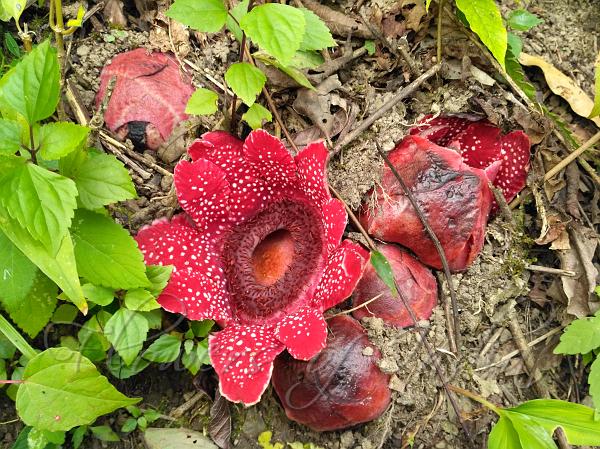
Botanical name: Sapria himalayana Family: Rafflesiaceae (Rafflesia family)
Himalayan Sapria is a rare and interesting root parasite plant on the roots
of plants of grape family. It is at the brink of
extinction due to incessant human interventions in the natural forest
environment, and has been included under the endangered category in the
Red Data Book of the Botanical Survey of India. It is
related to the better known Rafflesia. The flowers of Himalayan sapria are
20 cm across, unisexual, bright red in colour covered with
sulphur-yellow spots. They appear above the ground and have
a putrid odour. Flowering shoot is short, erect and unbranched. Buds are
globose and have white and pink bracts.
Flower remains in its blooming stage for 2–3 days and after that it
slowly splits open and becomes dark in colour and subsequently decomposes
slowly. Fruits are swollen and crowned with perianth. The seeds are of
the size of a grape fruit and blackish-brown in colour.
Himalayan Sapria was first reported from Arunachal Pradesh, and is
also distributed in Assam, Manipur and Meghalaya. At a global level,
Himalayan Sapria has been reported only from northeastern India and Thailand.
Flowering: December-February.
| Identification credit: Tabish | Photographed in Machi village, Chandel distt, Manipur. |
• Is this flower misidentified? If yes,