
| Himalayan Vase-Flower |

|
 |

|


| File size | 532164 |
| Original date | 5/11/26 12:49 PM |
| Resolution | 1600 x 1200 |
| Flash | Flash did not fire, auto |
| Focal length | 4.71mm |
| Exposure time | 1/2388s |
| Aperture | 1.7 |
| Focus Distance | |
| Metering Mode | Center weighted average |
| Camera make | motorola |
| Camera model | moto g85 5G |
| Sensor type | MonochromeArea |
 |
 ative ative |
 |
 |
 |
Photo: |
Botanical name: Rydingia limbata Family: Lamiaceae (Mint family)
Synonyms: Otostegia limbata, Ballota limbata
Synonyms: Otostegia limbata, Ballota limbata
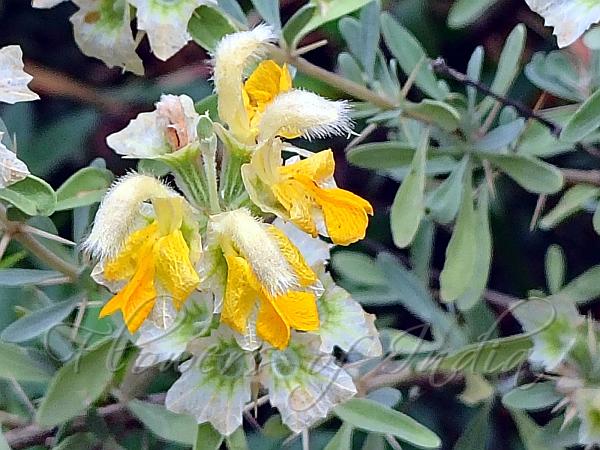
Himalayan Vase-Flower is small shrub up to 2 ft tall,
much branched. Flowers are borne in 6-10-flowered whorls, all remote.
Bracts are several, hard-spiny, about 1 cm long, pale-colored,
spreading-erect. Sepal-cup is funnel-shaped, 10-nerved; limb dilated,
membranous, margin 4-toothed. Flowers are yellow or orange-yellow,
1.5-2 cm long. Flower-tube is about 7 mm, as long as sepal-tube, upper
lip erect, concave, crown hairy; lower spreading, 3-parted, midlobe
broad. Stamens are 4, rising up. Style is almost equally 2-parted.
Stems are palish yellow or brown, four-edged on younger shoots,
velvet-hairy with short spreading eglandular hairs. Leaves are
clustered, oblong-inverted-lanceshaped, entire, 1-2 cm long, 5-8 mm
broad, finely glandular-dotted and with short adpressed hairs, blunt at
tip, narrowed at base, spread over stem and merging into the bracts.
Spines are about 1 cm long, in axils. Himalayan Vase-Flower is found in
Pakistan to Western Himalaya. Flowering: April-May.
Medicinal uses: Himalayan Vase-Flower is
consumed for the treatment of children's gum problems, for remedial
purpose in case of ophthalmia in man and also used for curing the
wounds in beast and man. Locally fresh leaves of the plant are crushed
and then grounded, after that water is mixed to make the extract which
is also used for the cure of eye infections.
Himalayan Vase-Flower is
consumed for the treatment of children's gum problems, for remedial
purpose in case of ophthalmia in man and also used for curing the
wounds in beast and man. Locally fresh leaves of the plant are crushed
and then grounded, after that water is mixed to make the extract which
is also used for the cure of eye infections.
Medicinal uses:
Himalayan Vase-Flower is
consumed for the treatment of children's gum problems, for remedial
purpose in case of ophthalmia in man and also used for curing the
wounds in beast and man. Locally fresh leaves of the plant are crushed
and then grounded, after that water is mixed to make the extract which
is also used for the cure of eye infections. | Identification credit: Seema Bin Zeenat, Tabish | Photographed in Mendhar, Poonch, J&K. |
• Is this flower misidentified? If yes,