
| Honey Suckle Mistletoe |

|
 |

|


 |
 ative ative |
 |
Photo: |
Botanical name: Dendrophthoe falcata Family: Loranthaceae (Mistletoe family)
Synonyms: Loranthus loniceroides, Loranthus falcatus, Loranthus indicus Desr.
Synonyms: Loranthus loniceroides, Loranthus falcatus, Loranthus indicus Desr.
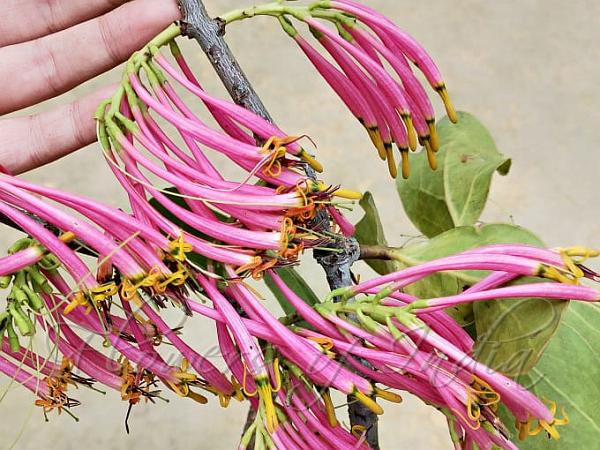
Honey Suckle Mistletoe is a large branch parasite. It is a shrub which is
much branched, 1-3 m long. Branches are swollen from the base, and the bark
is dark gray. Oppositely arranged leaves are 7-15 cm long, variable in
shape. Leaf stalks are 1 cm long, and the midriff is red. Flowers occur in
stout racemes in leaf axils. The flowers buds look like long white tubes.
Flower tube is 3-5 cm long, pink to white. The five narrow
petals or lobes of the flower tube, greenish or yellowish, are upturned.
Stamens, 4-6 protrude out of the flower. The green style is slender and is
longer than the stamens. The plant has a very close cousin with red flowers,
Red Honey Suckle Mistletoe.
Flowering: January-February.
| Identification credit: Pravin Kawale | Photographed in Tripura & Maharashtra. |
• Is this flower misidentified? If yes,