
| Indian Caper |

|
 |

|
| File size | 136126 |
| Original date | 11/8/08 10:45 AM |
| Resolution | 1024 x 768 |
| Flash | Flash did not fire, auto |
| Focal length | 7.8mm |
| Exposure time | 1/93s |
| Aperture | 2.8 |
| Focus Distance | |
| Metering Mode | Multi-segment |
| Camera make | NIKON |
| Camera model | E5200 |
| Sensor type |
 |
 ative ative |
 |
 |
Photo: |
Botanical name: Capparis brevispina Family: Capparaceae (Caper family)
Synonyms: Capparis wallichiana
Synonyms: Capparis wallichiana
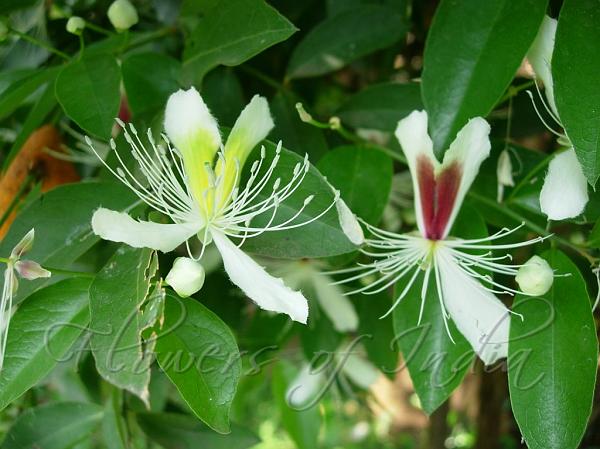
Indian Caper is a shrub armed with thorny stipules. Leaves are short-
stalked, varying from broad-lanceshaped to oval, more or less pointed,
mucronate, paler beneath. Flowers are borne singly in leaf axils, on stalks
as long as the leaves. Flowers are large, 2 inches across, white, two upper
petals tinged yellow, maturing to red. Anthers are blue. Berry is smooth,
red when ripe. Indian Caper is common in the Malabar region, on dry rocky
ground.
Identification credit: Shrikant Ingalhalikar
| Photographed in Jijamata Udyan, Mumbai. |