
| Indian Cherry |

|
 |

|


| File size | 304356 |
| Original date | 4/6/08 9:32 AM |
| Resolution | 1536 x 1152 |
| Flash | Flash did not fire, auto |
| Focal length | 82.8mm |
| Exposure time | 1/125s |
| Aperture | 4.2 |
| Focus Distance | |
| Metering Mode | Multi-segment |
| Camera make | Panasonic |
| Camera model | DMC-FZ18 |
| Sensor type | OneChipColorArea |
 |
 ative ative |
 |
 |
Photo: |
Botanical name: Cordia dichotoma Family: Boraginaceae (Forget-me-not family)
Synonyms: Cordia indica, Cordia ixiocarpa, Cordia domestica
Synonyms: Cordia indica, Cordia ixiocarpa, Cordia domestica
Indian cherry is a small to medium-size deciduous tree with a short
crooked trunk, short bole and spreading crown. Leaves are simple,
entire and slightly toothed, elliptical-lanceshaped to broad ovate with
a round and heart-shaped base. The stem bark is grayish brown smooth or
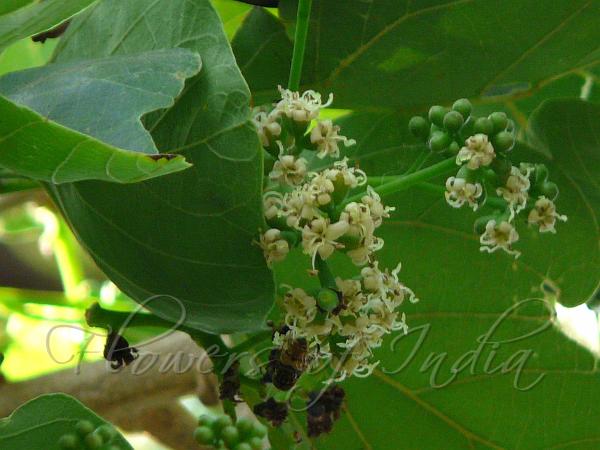
longitudinally wrinkled. Flowers are short stalked, bisexual and white
to pinkish in colour and appear in loose corymbose cymes. Flowers are
dimorphic, stalkless. Calyx is bell-shaped, 5-6 mm, 5-lobed; sepals unequal,
triangular. Flowers are about as long as calyx; petals shorter than
tube, margin somewhat wavy. Filaments of male flowers are about 3.5 mm,
filaments of bisexual flowers 1-2 mm. Fruits are edible with sticky flesh
mass. It is a yellow or pinkish-yellow shining spherical or ovoid drupe
seated in a saucer-like enlarged calyx. It turns black on ripening and
the pulp gets sticky. Indian cherry grows in the sub-Himalayan tract and
outer ranges, ascending up to about 1500 m altitude. It is found in
diverse of forests ranging from the dry deciduous forests of Rajasthan to
the moist deciduous forests of Western Ghats and tidal forests
in Myanmar. In Maharashtra, it grows in moist monsoon forest.
| Identification credit: Tabish | Photographed in Maharashtra & Delhi |
• Is this flower misidentified? If yes,