
| Indian Pennywort |

|
 |

|


| File size | 2475150 |
| Original date | 6/30/08 10:52 AM |
| Resolution | 2560 x 1920 |
| Flash | Flash did not fire, auto |
| Focal length | 4.6mm |
| Exposure time | 1/100s |
| Aperture | 3.2 |
| Focus Distance | |
| Metering Mode | Multi-segment |
| Camera make | Panasonic |
| Camera model | DMC-FZ18 |
| Sensor type | OneChipColorArea |
 |
 ative ative |
 |
 |
Photo: |
Botanical name: Centella asiatica Family: Apiaceae (Carrot family)
Synonyms: Centella hirtella, Hydrocotyle asiatica, Hydrocotyle reniformis
Synonyms: Centella hirtella, Hydrocotyle asiatica, Hydrocotyle reniformis
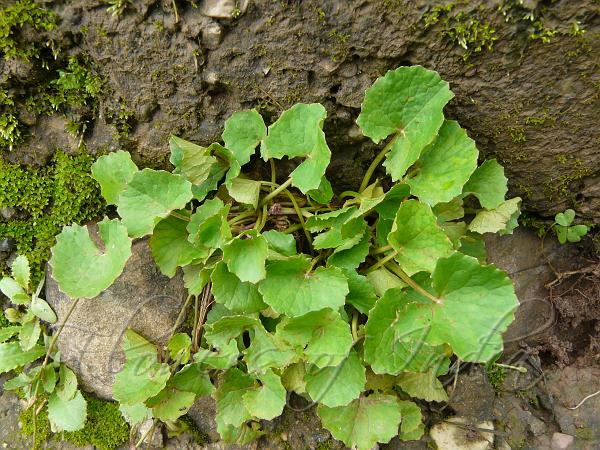
Indian Pennywort is a small creeping herb with
shovel shaped leaves emerging alternately in clusters at the stem
nodes. The runners lie along the ground and the inch long leaves with
their scalloped edges rise above on long reddish petioles. The
insignificant greenish- to pinkish-white flowers are borne in dense
umbels (clusters in which all the flower stalks arise from the same
point) on separate stems in the summer. The seeds are pumpkin-shaped
nutlets 0.1-0.2 in long. In India it is revered as a medicinal herb,
and particularly in Manipur the full plant is eaten as food like a
leafy vegetable. Indian Pennywort appears to have originated in the
wetlands of Asia. China, India, and Malaya were probably within its
original range.
Medicinal uses: Indian Pennywort is revered as
one of the great multi-purpose miracle herbs of Oriental medicine. It
has been in use for thousands of years and has been employed to treat
practically every ailment known to man at one time or place or another.
The leaf and root extract has been used in Ayurvedic medicine for a
long time but has become very popular in the past couple of years for
both internal use as well as topical application - although the
cosmetic application is relatively new. In Ayurvedic practice it also
has a valuable and sought-after Vayasthapana effect - helping to retard
the aging process.
Indian Pennywort is revered as
one of the great multi-purpose miracle herbs of Oriental medicine. It
has been in use for thousands of years and has been employed to treat
practically every ailment known to man at one time or place or another.
The leaf and root extract has been used in Ayurvedic medicine for a
long time but has become very popular in the past couple of years for
both internal use as well as topical application - although the
cosmetic application is relatively new. In Ayurvedic practice it also
has a valuable and sought-after Vayasthapana effect - helping to retard
the aging process.
Medicinal uses:
Indian Pennywort is revered as
one of the great multi-purpose miracle herbs of Oriental medicine. It
has been in use for thousands of years and has been employed to treat
practically every ailment known to man at one time or place or another.
The leaf and root extract has been used in Ayurvedic medicine for a
long time but has become very popular in the past couple of years for
both internal use as well as topical application - although the
cosmetic application is relatively new. In Ayurvedic practice it also
has a valuable and sought-after Vayasthapana effect - helping to retard
the aging process. | Identification credit: Thingnam Girija | Photographed in Dharamshala, Himachal Pradesh & Imphal, Manipur. |
• Is this flower misidentified? If yes,