
| Indian Valerian |

|
 |

|
| File size | 703229 |
| Original date | 8/16/06 9:21 AM |
| Resolution | 2048 x 1536 |
| Flash | Flash did not fire, auto |
| Focal length | 8.0mm |
| Exposure time | 1/67s |
| Aperture | 3.2 |
| Focus Distance | |
| Metering Mode | Partial |
| Camera make | NIKON |
| Camera model | E3700 |
| Sensor type |
 |
 ative ative |
 |
Photo: |
Botanical name: Valeriana hardwickei Family: Caprifoliaceae (Honeysuckle family)
Synonyms: Valeriana hardwickeana, Valeriana hardwickii, Valeriana elata
Synonyms: Valeriana hardwickeana, Valeriana hardwickii, Valeriana elata
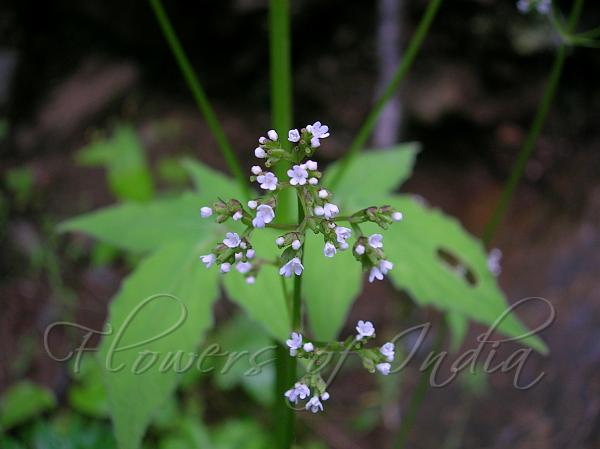
Indian Valerian is a perennial herb, distinguished by its 1-3 pairs of
stem-leaves which are large, compound, with 3-5 leaflets, and its white or
pale pink flowers. These tiny flower, 2-3 mm across, are borne in dense,
domed clusters at the end of branches. The clusters form a branched pyramidal
inflorescence. Basal leaves are long-stalked, and are usually shriveled
during flowering. Stem is 1-6 ft tall. Indian Valerian is found in
shrubberies and open slopes, at altitudes of 1500-4000 m.
Flowering: June-September.
Medicinal uses: Indian Valerian is a well-known and frequently
used medicinal herb that has a long and proven history of efficacy. It is
noted especially for its effect as a tranquilliser and nervine,
particularly for those people suffering from nervous overstrain. Valerian
has been shown to encourage sleep, improve sleep quality and reduce blood
pressure.
Indian Valerian is a well-known and frequently
used medicinal herb that has a long and proven history of efficacy. It is
noted especially for its effect as a tranquilliser and nervine,
particularly for those people suffering from nervous overstrain. Valerian
has been shown to encourage sleep, improve sleep quality and reduce blood
pressure.
Medicinal uses:
Indian Valerian is a well-known and frequently
used medicinal herb that has a long and proven history of efficacy. It is
noted especially for its effect as a tranquilliser and nervine,
particularly for those people suffering from nervous overstrain. Valerian
has been shown to encourage sleep, improve sleep quality and reduce blood
pressure. | Identification credit: Gajendra Singh | Photographed in Valley of Flowers, Uttarakhand. |
• Is this flower misidentified? If yes,