
| Jamaica Cherry |

|
 |

|


 |
 ntroduced ntroduced |
 |
 |
Photo: |
Botanical name: Muntingia calabura Family: Muntingiaceae (Jamaica Cherry family)
Jamaica Cherry is a very fast-growing tree of slender proportions,
reaching 25 to 40 ft in height, with spreading, nearly horizontal
branches. The leaves are evergreen, alternate, lanceolate or ovate,
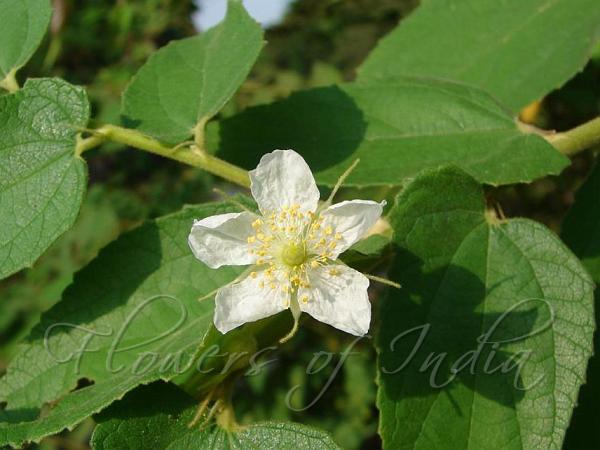
long-pointed at the apex, oblique at the base. The flowers with 5 green
sepals and 5 white petals and many prominent yellow stamens last only one
day, the petals falling in the afternoon. Flowers resemble strawberry
bloom, hence the common name, Strawberry tree. The abundant fruits are
round, 1-1.25 cm wide, with red or sometimes yellow, smooth, thin, tender
skin and light-brown, soft, juicy pulp, with very sweet, musky, somewhat
fig-like flavor, filled with exceedingly minute, yellowish seeds, too fine
to be noticed in eating. The tree has the reputation of thriving with no
care in poor soils. It is drought-resistant but not salt-tolerant.
Wherever it grows, fruits are borne nearly all year. The leaf infusion is
drunk as a tea-like beverage. Fruits contain hundreds of tiny seeds.
Medicinal uses: The flowers are said to possess antiseptic
properties. An infusion of the flowers is valued as an antispasmodic. It
is taken to relieve headache and the first symptoms of a cold.
The flowers are said to possess antiseptic
properties. An infusion of the flowers is valued as an antispasmodic. It
is taken to relieve headache and the first symptoms of a cold.
Medicinal uses:
The flowers are said to possess antiseptic
properties. An infusion of the flowers is valued as an antispasmodic. It
is taken to relieve headache and the first symptoms of a cold. | Identification credit: Nandan Kalbag | Photographed in Maharashtra & Devanahalli, Karnataka. |
• Is this flower misidentified? If yes,