
| Jammu Onion |

|
 |

|


| File size | 1881040 |
| Original date | 4/27/24 11:52 AM |
| Resolution | 2048 x 1536 |
| Flash | Flash did not fire |
| Focal length | 40.0mm |
| Exposure time | 1/320s |
| Aperture | 29.0 |
| Focus Distance | |
| Metering Mode | Multi-segment |
| Camera make | NIKON CORPORATION |
| Camera model | NIKON D5300 |
| Sensor type | OneChipColorArea |
 |
 ative ative |
 |
 |
 |
Photo: |
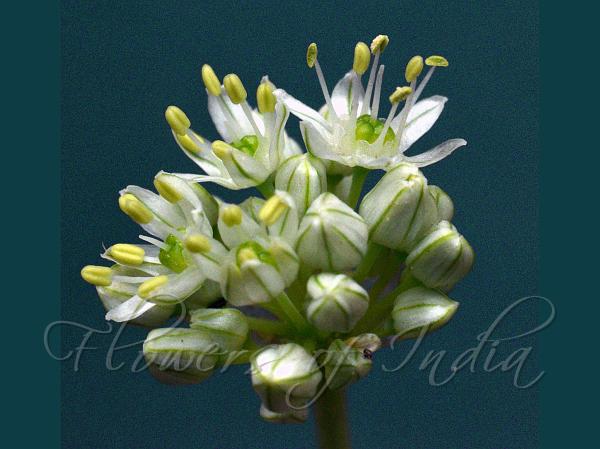
Botanical name: Allium jammuense Family: Amaryllidaceae (Nargis family)
Jammu Onion is a newly discovered perennial herb,
somewhat similar to
Allium roylei. Flowers are borne
in a hemispheric, 17-25 lax flowered umbel, about 1.6 cm in diameter,
atop a foot long leafless stem. Flowers are bisexual, without bulbils;
flower-stalks slender, nearly equal, 1.2-1.7 cm x 1-2 mm, hairless.
Tepals are 6, white with distinct green mid-nerve, elliptic-oblong,
7-11 x 3-5 mm, tip somewhat pointed to blunt, fused at base,
membranous, hairless. Stamens are 6, dissimilar; filaments nearly
equal, 2 shorter, 4 longer, 4.5-7 mm long, slightly protruding, fused
at base; anthers elliptic, yellowish, 2-3.2 mm long. Ovary is nearly
spherical, green, 0.4-0.6 × 1 mm, 3-lobed, each lobe mid- grooved;
style white, round, sharp-tipped, about 1.3 mm long; stigma
inprominent. Bulbs are narrowly ovoid, 3.8-6.6 x 0.8-1.2 cm, outer
tunic reddish-dark brown, membranous, leathery, inner ones lighter in
color, sparsely rooting from base. Leaves are basal, erect, up to 4-6,
shorter than the flowering stem, 15-35 x about 0.1 cm, hollow, round,
smooth, dark green. Flowering stem is round, erect, covered with leaf
sheaths at base only, solid in early stage, hollow when mature, 16-32 x
0.1 cm. Spathe is boat-shaped, persistent, beaked, membranous, entire,
about 1 cm long. Capsules are obovoid, seeds rectangular-oblong,
smooth, black. Jammu Onion is known only from the Trikuta Hills of
Jammu, at altitudes of 1250-1670 m. Flowering: May-June.
| Identification credit: Anant Kumar, Sunit SIngh | Photographed in Trikuta Hills, Jammu. |
• Is this flower misidentified? If yes,