
| Lablab Bean |

|
 |

|


| File size | 410874 |
| Original date | 10/28/08 12:39 PM |
| Resolution | 2048 x 1536 |
| Flash | Flash did not fire, auto |
| Focal length | 13.6mm |
| Exposure time | 1/37s |
| Aperture | 4.3 |
| Focus Distance | |
| Metering Mode | Multi-segment |
| Camera make | NIKON |
| Camera model | E3700 |
| Sensor type |
 |
 ative ative |
 |
 |
Photo: |
Botanical name: Lablab purpureus Family: Fabaceae (Pea family)
Synonyms: Dolichos lablab, Dolichos purpureus
Synonyms: Dolichos lablab, Dolichos purpureus
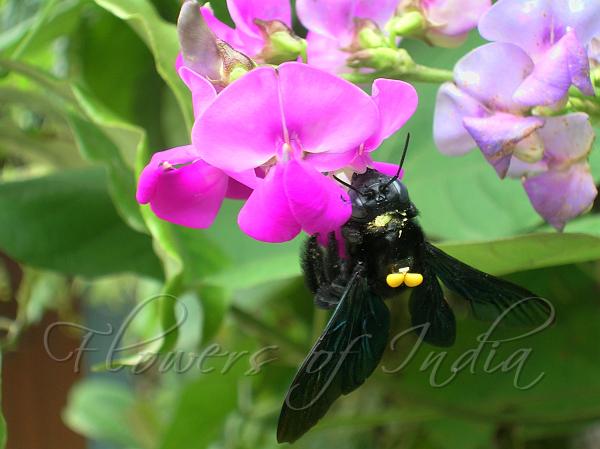
Lablab bean is a twining vine with leaves divided into 3 leaflets, and
attractive bright purple flowers and a purple pods. The vine becomes woody
and can reach more than 30 ft in length. The leaflets are purplish green,
broad oval or triangular in shape and 3-6 in long. Flowers are typically
shaped like pea flowers, a rich, brilliant purple and arranged in loose
clusters on long stems that extend above the foliage. For this reason,
Lablab bean is frequently grown as an ornamental vine. The pods are just
as showy as the flowers. They are flat and curved, about 3 in long, bright
purple. The beans inside are dark colored with a conspicuous white eye.
The pod is widely eaten in India.
| Identification credit: Thingnam Sophia | Photographed in Imphal, Manipur. |
• Is this flower misidentified? If yes,