
| Lakoocha |

|
 |

|


| File size | 717333 |
| Original date | 4/1/17 5:40 PM |
| Resolution | 2048 x 1536 |
| Flash | Flash did not fire, auto |
| Focal length | 32.1mm |
| Exposure time | 1/40s |
| Aperture | 4.5 |
| Focus Distance | |
| Metering Mode | Multi-segment |
| Camera make | Panasonic |
| Camera model | DMC-TZ10 |
| Sensor type | OneChipColorArea |
 |
 ative ative |
 |
 |
Photo: |
Botanical name: Artocarpus lacucha Family: Moraceae (Mulberry family)
Synonyms: Artocarpus lakoocha, Artocarpus ficifolius
Synonyms: Artocarpus lakoocha, Artocarpus ficifolius
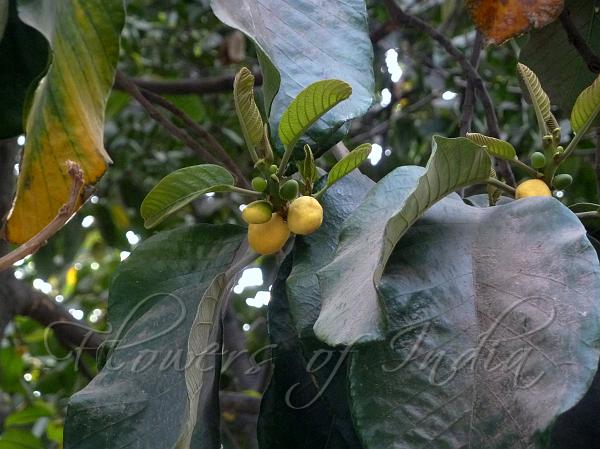
Lakoocha is a deciduous tree, 10-15 m tall. Branchlets are 3-6 mm thick,
densely covered with stiff pale brown to yellow velvety hairs. Stipules
are ovate-lanceshaped, 4-5 cm long. Elliptic leaves, on 2-3 cm long
stalks, are densely covered with yellow bristles. Leaves are large, 25-30
cm long, 15-20 cm wide, sometimes pinnately lobed, base wedge-shaped, tip
blunt. Leaf margin is entire or with small teeth. Flowers are tiny,
yellowish, fused into a round flower body. The fruits are nearly round or
irregular, 2 to 5 inches wide, velvety, dull-yellow tinged with pink, with
sweet sour pulp which is occasionally eaten raw but mostly made into
curries or chutney. The male flower spike is pickled. Lakoocha is native
to the Indian subcontinent and SE Asia. Flowering: April-June.
| Identification credit: Tabish | Photographed in Delhi. |
• Is this flower misidentified? If yes,