
| Lavang Lata |

|
 |

|


 |
 ative ative |
 |
 |
Photo: |
Botanical name: Luvunga scandens Family: Rutaceae (Lemon family)
Synonyms: Limonia scandens, Luvunga nitida
Synonyms: Limonia scandens, Luvunga nitida
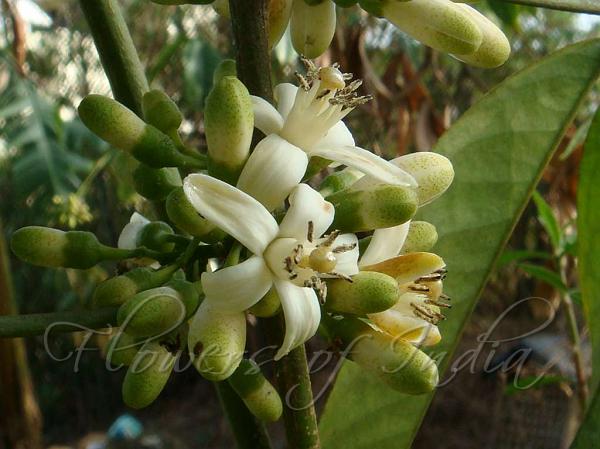
Lavang Lata is a strong woody climber with recurved spines,
native to North-East India. It belongs to the family of lemon and orange.
Unfortunately, it has now become a rare and endangered species.
Leaves are compound, with 3 leaflets which
are lancelike and leathery. Leaf stalks are chanelled. Peduncles carrying
4-12 pretty large, white, fragrant flowers, arise from leaf axils.
Flowers are shaped like
the flowers of most citrus plants. Fruit is oblong, 2.5 x 2 cm in size,
yellowish, with smooth aromatic peel and resinous, fragrant pulp. The fruit
has 1-3 ovoid seeds. This evergreen plant is sometimes grown for ornamental
purposes. Flowering: March-April.
Medicinal uses: Dried fruits are used in making medicinal oil. Roots and fruits are employed for treating scorpion-stings.
Medicinal uses:
Dried fruits are used in making medicinal oil. Roots and fruits are employed for treating scorpion-stings. | Identification credit: Thingnam Sophia | Photographed in Imphal, Manipur. |
• Is this flower misidentified? If yes,