
| Malabar Bauhinia |

|
 |

|


| File size | 377785 |
| Original date | 10/10/09 1:13 PM |
| Resolution | 2048 x 1536 |
| Flash | Flash did not fire, auto |
| Focal length | 200.0mm |
| Exposure time | 1/100s |
| Aperture | 5.6 |
| Focus Distance | |
| Metering Mode | Multi-segment |
| Camera make | Panasonic |
| Camera model | DMC-G1 |
| Sensor type | OneChipColorArea |
 |
 ative ative |
 |
 |
Photo: |
Botanical name: Piliostigma malabaricum Family: Caesalpiniaceae (Gulmohar family)
Synonyms: Bauhinia malabarica, Bauhinia acida, Bauhinia reniformis
Synonyms: Bauhinia malabarica, Bauhinia acida, Bauhinia reniformis
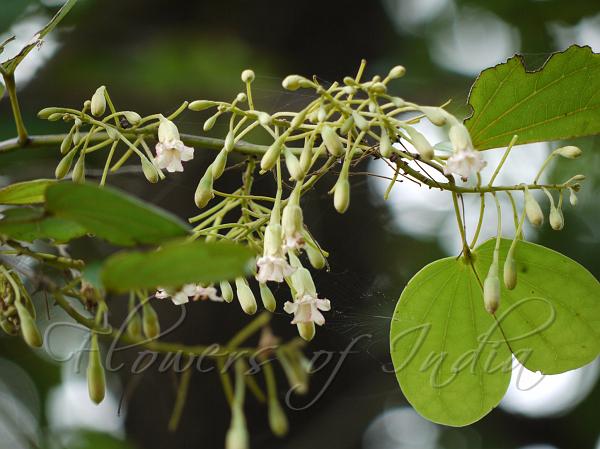
Malabar Bauhinia is a small or moderate sized deciduous tree. Bark is
rough brown, peeling in linear flakes, fibrous, red inside. Leaves are
broader than long, 1.5-4 inches long, 2-5 inches broad, divided through
1/3 of the length, 7-9 nerved, slightly heart-shaped at base, rigidly
leathery, glaucous and smooth beneath. Flowers are borne in stalkless
racemes in leaf axils, 1.5-2 inches long, often 2-3 together. Flowers are
1/2 inch long, dull-white, often uni-sexual, on very slender stalks, which
are 1 in. long. Male and female flowers are usually on different stems.
Sepal cup has 5 equal triangular teeth. Petals are spade-shaped, equal.
Pod is 7-12 inches long, 2-2.5 cm broad, on a stalk 1 in. long, flat
flexible, many-seeded, more or less straight reticulate veins, which
starting diagonally from both sutures meet in the middle. Seeds are 20-30.
| Identification credit: Shrikant Ingalhalikar | Photographed at Nagla forest, Sanjay Gandhi National Park, Maharashtra. |
• Is this flower misidentified? If yes,