
| Marijuana |

|
 |

|


| File size | 471812 |
| Original date | 6/17/06 12:23 PM |
| Resolution | 2048 x 1536 |
| Flash | Flash did not fire, auto |
| Focal length | 8.0mm |
| Exposure time | 1/214s |
| Aperture | 3.2 |
| Focus Distance | |
| Metering Mode | Partial |
| Camera make | NIKON |
| Camera model | E3700 |
| Sensor type |
 |
 ative ative |
 |
 |
Photo: |
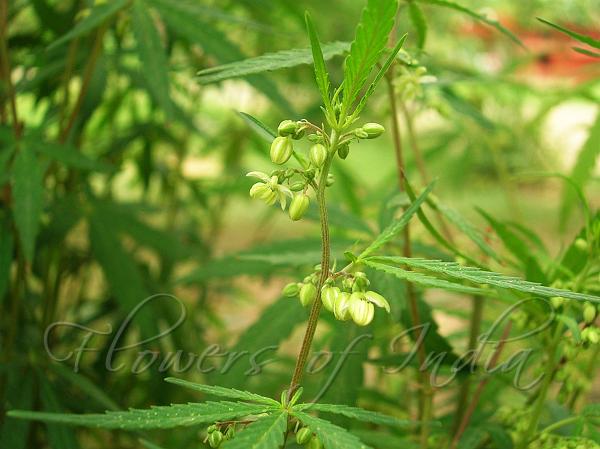
Botanical name: Cannabis sativa Family: Cannabaceae (Marijuana family)
Synonyms: Cannabis indica, Cannabis chinensis, Cannabis generalis
Synonyms: Cannabis indica, Cannabis chinensis, Cannabis generalis
Marijuana, is a coarse, rangy annual that grows
6-12 ft in height. The leaves are palmately divided into 3-7 narrow,
toothed segments, most about 3-6 in long. The stems are rough and
scabrous and the inner bark is fibrous. Hemp is normally a dioecious
species, with male and female flowers on separate plants, but sometimes
bisexual plants occur. The female flowers are in greenish leafy spikes
a little less than 1 in long, borne on stem tips, and the male flowers
are yellowish, tiny, and borne in axillary clusters. The flowers are
inconspicuous and without scent; they are pollinated not by insects,
but by the wind. The fruit is an achene, which is a hard, one-seeded
fruit that remains closed at maturity. There is only one species of
Cannabis, but numerous forms have been selected for various purposes.
The hemp plant is not particularly attractive and has no ornamental
qualities. The tough fiber of the plant, cultivated as hemp, has
numerous textile uses. Its seed, chiefly used as caged-bird feed, is a
valuable source of protein, energy, and psychoactive and
physiologically active chemical compounds known as cannabinoids that
are consumed for recreational, medicinal, and spiritual purposes. When
so used, preparations of flowers and leaves, sometimes called
marijuana, and preparations derived from resinous extract, sometimes
called hashish, are usually consumed by inhaling a vapor released by
smoking or heating, or by oral ingestion. Historically, tinctures,
teas, and ointments were also common preparations.
Medicinal uses:  The Cannabis plant has a history of medicinal use dating back thousands
of years across many cultures. Its usage in modern times is
controversial, and in recent years the American Medical Association,
the MMA, the American Society of Addiction Medicine, and other medical
organizations have issued statements opposing its usage for medicinal
purposes.
The Cannabis plant has a history of medicinal use dating back thousands
of years across many cultures. Its usage in modern times is
controversial, and in recent years the American Medical Association,
the MMA, the American Society of Addiction Medicine, and other medical
organizations have issued statements opposing its usage for medicinal
purposes.
The Cannabis plant has a history of medicinal use dating back thousands
of years across many cultures. Its usage in modern times is
controversial, and in recent years the American Medical Association,
the MMA, the American Society of Addiction Medicine, and other medical
organizations have issued statements opposing its usage for medicinal
purposes. | Identification credit: R.K. Nimai Singh | Photographed in Delhi. |
• Is this flower misidentified? If yes,