
| Musk Mallow |

|
 |

|


 |
 ative ative |
 |
 |
Photo: |
Botanical name: Abelmoschus moschatus Family: Malvaceae (Mallow family)
Synonyms: Hibiscus abelmoschus
Synonyms: Hibiscus abelmoschus
Musk Mallow is a
herb or undershrub, erect 0.5-3 m tall. Stem is simple and retrorse hairy,
bristly to prickly. Leaves are 6-30 cm long and broad, round or broadly ovate,
heart-shaped at base, not or 3-7 lobed or parted, bristly on both sides;
lobes deltoid to oblong-lanceshaped, sawtoothed to toothed or rounded
toothed or rarely entire; stipules linear or thread-like, 6-12 mm long,
simple hairy; leaf-stalk 2-30 cm long, bristly. Flowers arise in leaf-axils,
solitary, flower-stalk 2-8 cm long, in fruit up to 19 cm. False sepals are
6-10, 8-20 mm long, 1-2.5 mm broad, appressed, linear
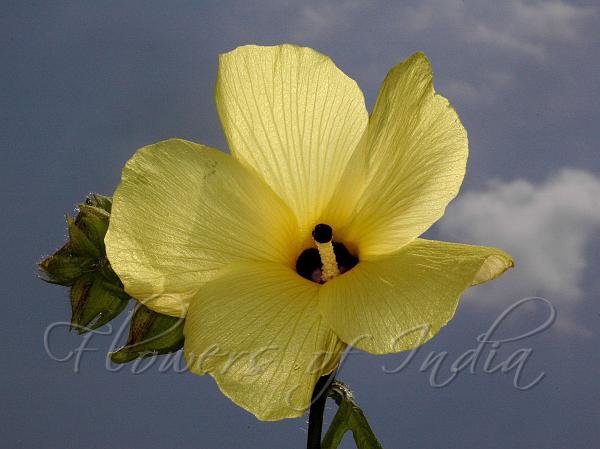
to lanceshaped. Sepal-cup 2-3.5 cm long. Flower 10 cm across, yellow with
a deep purple spot at the base; petals 7-9 cm long, 2-5.5 cm broad,
fringed with hairs at base. Staminal tube 1.5-2 cm long. Capsule 5-8 cm
long, 2-3.5 cm across, ovoid to spindle-shaped, densely simple hairy,
usually bristly. Seeds 3-4 mm across, ovoid-kidney-shaped, usually
hairless or rarely star-shaped velvet-hairy, black.
Medicinal uses: Musk Mallow is used as an antidote for
snakebites. An emulsion from the seeds is considered to be anti-spasmodic
and is used externally. Extensively used as an insecticide and a
aphrodisiac. The oil of the seeds, with a strong musk odor, are also used
in the perfume industry (now largely replaced by synthetic musk oils) and
is used to flavor coffee.
Musk Mallow is used as an antidote for
snakebites. An emulsion from the seeds is considered to be anti-spasmodic
and is used externally. Extensively used as an insecticide and a
aphrodisiac. The oil of the seeds, with a strong musk odor, are also used
in the perfume industry (now largely replaced by synthetic musk oils) and
is used to flavor coffee.
Medicinal uses:
Musk Mallow is used as an antidote for
snakebites. An emulsion from the seeds is considered to be anti-spasmodic
and is used externally. Extensively used as an insecticide and a
aphrodisiac. The oil of the seeds, with a strong musk odor, are also used
in the perfume industry (now largely replaced by synthetic musk oils) and
is used to flavor coffee. | Identification credit: Navendu Pāgé | Photographed in Dehradoon, Uttarakhand. |
• Is this flower misidentified? If yes,