
| Narrowleaf Emilia |

|
 |

|


| File size | 359611 |
| Original date | 6/29/25 1:15 PM |
| Resolution | 1560 x 1170 |
| Flash | Flash did not fire, auto |
| Focal length | 4.8mm |
| Exposure time | 1/160s |
| Aperture | 4.0 |
| Focus Distance | |
| Metering Mode | Multi-segment |
| Camera make | Panasonic |
| Camera model | DMC-FZ35 |
| Sensor type | OneChipColorArea |
 |
 ative ative |
 |
 |
 |
Photo: |
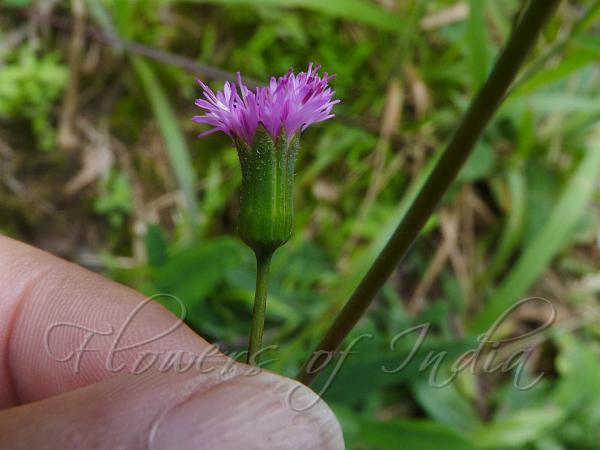
Botanical name: Emilia prenanthoidea Family: Asteraceae (Sunflower family)
Synonyms: Emilia angustifolia, Cacalia angustifolia,
Synonyms: Emilia angustifolia, Cacalia angustifolia,
Narrowleaf Emilia is an annual herb with stems erect
or rising up, 30-90 cm tall, hairless or sparsely hairy. Flower-heads
are arranged in branch-end lax corymbs, carried on
flower-cluster-stalks 3-10 cm, slender. Florets are red or purple-red;
flower about 1 cm, tube slender, limb 5-lobed; lobes lanceshaped, 2-3
mm. Style branches at tip thickened. Involucres is cylindric or
narrowly bell-shaped, 6-11 x 2-3 mm; phyllaries 10, oblong, 6-12 × 1-2
mm, shorter than florets, hairless, margin scarious. Achenes cylindric,
about 3 mm, hairless, 5-ribbed. Pappus of capillary-like bristles,
soft, white. Basal leaves are obovate or obovate-oblong, small, base
gradually narrowed into long leaf-stalk, margin entire or laxly
toothed, tip blunt. Median leaves are stalkless, below sometimes
purplish, above green, oblong or linear-oblong, 5-9 x 1-3 cm, hairless
or nearly so, base semi-stem-clasping, arrowshaped or eared, margin
wavy-toothed, tip blunt or pointed. Upper leaves linear-lanceshaped,
small. Narrowleaf Emilia is found on roadsides on slopes, lax forests,
wet places in forests, at altitudes of 500-2000 m, in East Himalaya to
SE Asia. Flowering: May-October.
Medicinal uses: Narrowleaf Emilia is a popular
medicinal plant among Miao people in Guizhou, China. It has
anti-inflammatory and antitumor properties. It is often used as a
medication for healing injury, clearing heat and detoxifying, boosting
blood circulation and eliminating blood stasis, and lowering
inflammation and diuresis.
Narrowleaf Emilia is a popular
medicinal plant among Miao people in Guizhou, China. It has
anti-inflammatory and antitumor properties. It is often used as a
medication for healing injury, clearing heat and detoxifying, boosting
blood circulation and eliminating blood stasis, and lowering
inflammation and diuresis.
Medicinal uses:
Narrowleaf Emilia is a popular
medicinal plant among Miao people in Guizhou, China. It has
anti-inflammatory and antitumor properties. It is often used as a
medication for healing injury, clearing heat and detoxifying, boosting
blood circulation and eliminating blood stasis, and lowering
inflammation and diuresis. | Identification credit: Tabish, Thingnam Rajshree | Photographed in Meghalaya. |
• Is this flower misidentified? If yes,