
| Narrowleaf Indigo |

|
 |

|


 |
 ative ative |
 |
 |
 |
Photo: |
Botanical name: Indigofera linifolia Family: Fabaceae (Pea family)
Synonyms: Hedysarum linifolium, Indigofera linifolia var. campbelli
Synonyms: Hedysarum linifolium, Indigofera linifolia var. campbelli
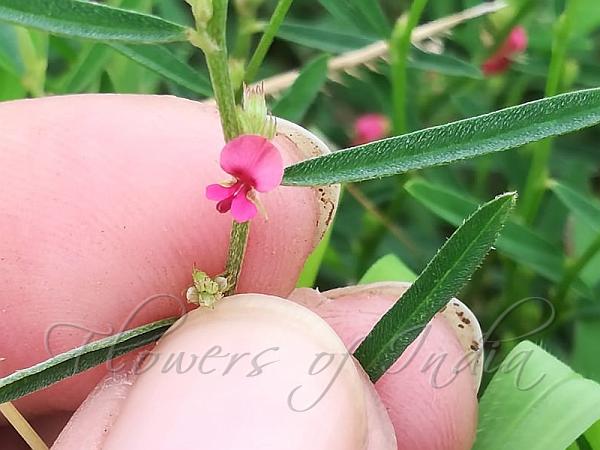
Narrowleaf Indigo is slender much-branched prostrate or erect annual or
bushy perennial, growing to 50 cm tall. Branches are velvety hairy with
appressed hairs. Nearly stalkless leaves are narrow, linear to
oblong-lanceolate, 20-45 x 2-4 mm, sharp-tipped, appressed-pubescent on
both surfaces. Inflorescence is a spike-like raceme, sitting on a short
peduncle. The raceme is to 3 cm long, 2-10-flowered; bracts
broad-lanceolate, 1 mm long, acute. Bright red flowers are 3-8 mm long.
Sepal tube at first pitcher-shaped 3-4 mm long, later bell-shaped. Sepals
linear, longer than the tube. Petals are bright-red, with the standard
petal circular, one-quarter longer than the calyx, wings and keel shorter.
Pod globular, 1.5-2 mm, apiculate, appressed-white-tomentose, 1-seeded;
seeds globular, 1.5 mm, brown-black, smooth. The plant is used as famine
food. The plant is threshed, and the seeds ground into flour for making
bread - either unmixed or combined with other cereals e.g. bajra (millet)
or jowar.
| Identification credit: Darshan Kokate, Tabish | Photographed at Kharghar & Hadsar fort, Maharashtra. |
• Is this flower misidentified? If yes,