
| Nepal Dock |

|
 |

|


| File size | 2481723 |
| Original date | 6/2/09 6:43 PM |
| Resolution | 2560 x 1920 |
| Flash | Flash did not fire, auto |
| Focal length | 55.4mm |
| Exposure time | 1/80s |
| Aperture | 3.6 |
| Focus Distance | |
| Metering Mode | Multi-segment |
| Camera make | Panasonic |
| Camera model | DMC-FZ18 |
| Sensor type | OneChipColorArea |
 |
 ative ative |
 |
Photo: Tabish |
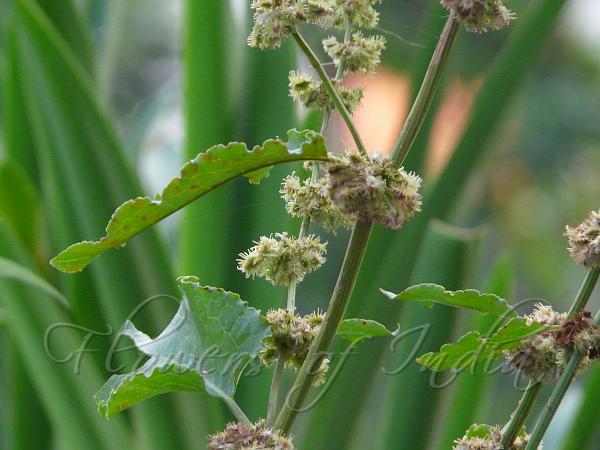
Botanical name: Rumex nepalensis Family: Polygonaceae (Knotweed family)
This plant grows abundantly in many parts of India, and is used by the
natives for its astringent qualities, and for dyeing purposes. These
are erect plants with long tap roots. The fleshy to leathery leaves
form a basal rosette at the root. The basal leaves may be different
from those near the inflorescence. The inconspicuous flowers are carried
above the leaves in whorl-like clusters. The fertile flowers are mostly
hermaphrodite, or they can be functionally male or female. The flowers
and seeds grow on long clusters at the top of a stalk emerging from
the basal rosette. Each seed is an 3-sided achene. Plants can contain
quite high levels of oxalic acid, which is what gives the leaves of many
members of this genus an acid-lemon flavour.
Medicinal uses: Leaf extract is applied to skin sores. Leaf
infusion is given in in colic and applied to syphiliitic ulcers. Leaves
are rubbed on the affected part for relief from irritation caused by
Bichchhoo plant.
Leaf extract is applied to skin sores. Leaf
infusion is given in in colic and applied to syphiliitic ulcers. Leaves
are rubbed on the affected part for relief from irritation caused by
Bichchhoo plant.
Medicinal uses:
Leaf extract is applied to skin sores. Leaf
infusion is given in in colic and applied to syphiliitic ulcers. Leaves
are rubbed on the affected part for relief from irritation caused by
Bichchhoo plant.| Identification credit: Nongthombam Ullysess | Photographed in Shimla, Himachal Pradesh. |
• Is this flower misidentified? If yes,