
| Nilgiri Cheesewood |

|
 |

|


| File size | 265316 |
| Original date | 1/31/26 2:59 PM |
| Resolution | 1080 x 810 |
| Flash | Flash did not fire, auto |
| Focal length | 49.07mm |
| Exposure time | 1/80s |
| Aperture | 3.9 |
| Focus Distance | |
| Metering Mode | Spot |
| Camera make | Panasonic |
| Camera model | DC-FZ10002 |
| Sensor type | OneChipColorArea |
 |
 ative ative |
 |
 |
 |
Photo: |
Botanical name: Pittosporum neelgherrense Family: Pittosporaceae (Pittosporum family)
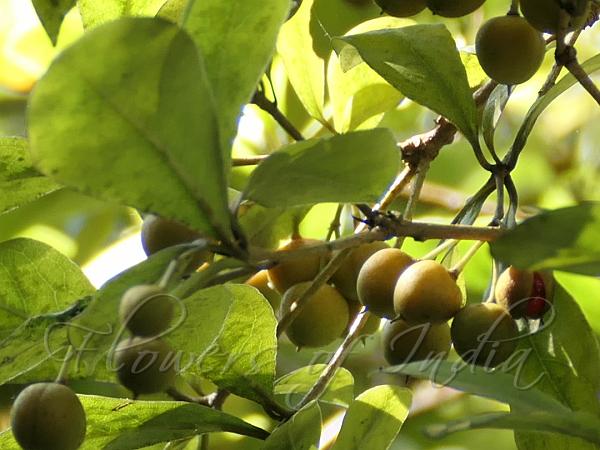
Nilgiri Cheesewood is a small tree up to 5 m tall.
Branchlets are slender, round, hairless, warty. Leaves are simple,
alternate, spiral, usually crowded at tip; leaf-stalk 0.5-1.2 cm long,
channeled, hairless; blade 2.5-10 x 1.3-5 cm, elliptic or obovate, tip
pointed or somewhat tapering, sometimes blunt, base pointed, margin
entire to crenulate; papery or thinly leathery, hairless. Midrib is
channeled; secondary nerves 5-8 pairs thin, branched. Flowers are borne
in few flowered racemes. Flowers are yellow, carried on stalks up to 1
cm long. Fruit is obliquely 2-valved, about 1 cm across; flower-stalk
thread-like; seeds 4-8. Nilgiri Cheesewood is found in Southern Western
Ghats.
Medicinal uses: The bark, about 5 mm thick, is
dull brown on the outside and creamy white on the inside. When cut, the
bark
emits an intense, foul smell. Members of Malappandaram community that
inhabits the evergreen forests of Pathanamthitta district, Kerala,
utilize this bark as an antidote to snake poison.
The bark, about 5 mm thick, is
dull brown on the outside and creamy white on the inside. When cut, the
bark
emits an intense, foul smell. Members of Malappandaram community that
inhabits the evergreen forests of Pathanamthitta district, Kerala,
utilize this bark as an antidote to snake poison.
Medicinal uses:
The bark, about 5 mm thick, is
dull brown on the outside and creamy white on the inside. When cut, the
bark
emits an intense, foul smell. Members of Malappandaram community that
inhabits the evergreen forests of Pathanamthitta district, Kerala,
utilize this bark as an antidote to snake poison. | Identification credit: Rajeev Kumar Singh | Photographed in Kōdamūlal, Tamil Nadu. |
• Is this flower misidentified? If yes,