
| Opium Poppy |

|
 |

|


| File size | 78927 |
| Original date | 1/18/10 3:13 AM |
| Resolution | 0 x 0 |
| Flash | Flash did not fire |
| Focal length | 38.0mm |
| Exposure time | 1/125s |
| Aperture | 5.6 |
| Focus Distance | |
| Metering Mode | Multi-segment |
| Camera make | NIKON CORPORATION |
| Camera model | NIKON D60 |
| Sensor type | OneChipColorArea |
 |
 ntroduced ntroduced |
 |
 |
Photo: |
Botanical name: Papaver somniferum Family: Papaveraceae (Poppy family)
Opium poppy is the plant from which opium and poppy seeds are extracted.
It is an annual herb, 1-2 ft tall (up to 1.5 m in cultivation). Taproot is
erect, almost conical. Stems are erect, glaucous, hairless. Alternately
arranged leaves are ovate or oblong, 7-25 cm, both surfaces hairless,
glaucous and rather waxy, with veins distinct, slightly raised, base heart-
shaped, margin irregularly wavy-toothed, tip long pointed to blunt. Lower
leaves are shortly stalked but upper ones are stalkless and stem-clasping.
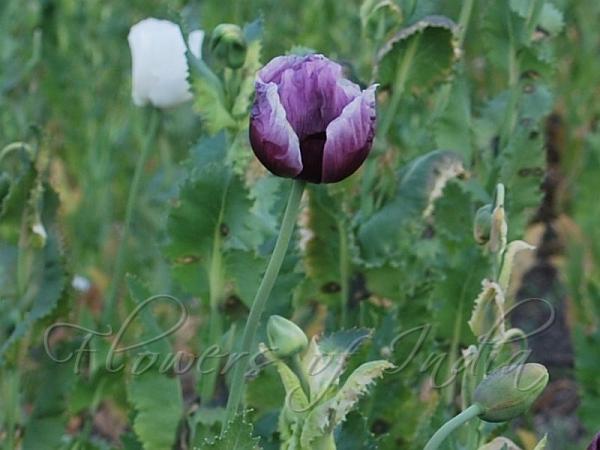
Flowers occur singly, deeply cup-shaped, 5-12 cm in diameter, born on long
stalks up to 25 cm. Flower buds are nodding at first, erect when the
flower opens fully, oval-oblong or broadly ovoid, 1.5-3.5 × 1-3 cm. Sepals
are 2, green, broadly ovate, margin membranous. Petals are 4, white, pink,
red, purple, or various, often with a dark basal blotch, roundish, 4-7 ×
3-11 cm, margin wavy or variously lobed. Stamens are many, with white
filaments 1-1.5 cm. Ovary is green, spherical, 1-2 cm in diameter, capped
by stigmas united into compressed star-like disk. Capsule are brown when
mature, spherical or oblong-elliptic, 4-9 × 4-5 cm. Seeds are many, black
or deep gray. Poppy seeds are commonly used in both North and South Indian
Cusine. They are called "khuskhus" in Hindi, "gasagasalu" in Telugu,
"gasagasa" in Kannada, and "posto dana" in Bengali. Poppy seeds can be dry
roasted and ground to be used in wet curry (curry paste) or dry curry.
Medicinal uses: Poppy is one of the most important medicinal
plants. Traditionally, the dry opium was considered an astringent,
antispasmodic, aphrodisiac, diaphoretic, expectorant, hypnotic, narcotic,
and sedative. Poppy has been used against toothaches and coughs. The
ability of opium from poppy to serve as an analgesic is well known. Opium
and derivatives of opium are used in the pharmaceutical industry as
narcotic analgesics, hypnotics, and sedatives. Opium and the drugs derived
from opium are addictive and can have toxicological effects.
Poppy is one of the most important medicinal
plants. Traditionally, the dry opium was considered an astringent,
antispasmodic, aphrodisiac, diaphoretic, expectorant, hypnotic, narcotic,
and sedative. Poppy has been used against toothaches and coughs. The
ability of opium from poppy to serve as an analgesic is well known. Opium
and derivatives of opium are used in the pharmaceutical industry as
narcotic analgesics, hypnotics, and sedatives. Opium and the drugs derived
from opium are addictive and can have toxicological effects.
Medicinal uses:
Poppy is one of the most important medicinal
plants. Traditionally, the dry opium was considered an astringent,
antispasmodic, aphrodisiac, diaphoretic, expectorant, hypnotic, narcotic,
and sedative. Poppy has been used against toothaches and coughs. The
ability of opium from poppy to serve as an analgesic is well known. Opium
and derivatives of opium are used in the pharmaceutical industry as
narcotic analgesics, hypnotics, and sedatives. Opium and the drugs derived
from opium are addictive and can have toxicological effects. | Identification credit: Sobhapati Samom | Photographed in Ukhrul distt, Manipur. |
• Is this flower misidentified? If yes,