
| Oregano |

|
 |

|


 |
 ative ative |
 |
 |
Photo: |
Botanical name: Origanum vulgare Family: Lamiaceae (Mint family)
Synonyms: Origanum creticum, Origanum officinale, Origanum orientale
Synonyms: Origanum creticum, Origanum officinale, Origanum orientale
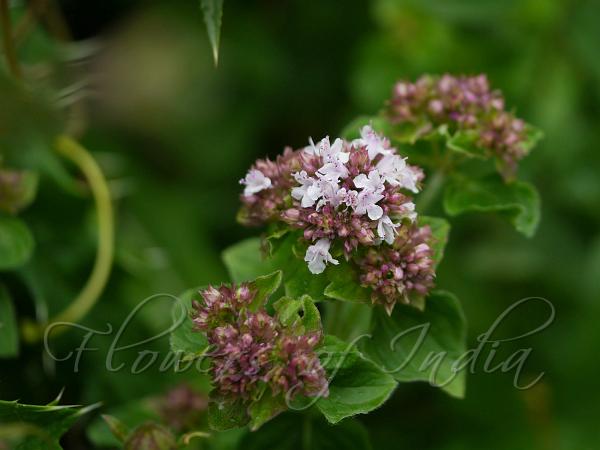
Oregano is a spicy, Mediterranean, perennial herb,
particularly common in Greek and Italian cuisines. It is an aromatic,
woody-based perennial, which grows to 20-90 cm in height. Its leaves
are ovate, 1-4 cm long and 0.5-2.5 cm wide, oppositely arranged. The
edges of the leaves are smooth or very shallowly toothed, and the leaf
tips vary from pointed to blunt. The flowers are tiny, borne in
many-flowered, short dense lateral or branch-end spikes. The flowers
are white to purplish, 4-8 mm long, and have two lips. The calyx is
five-toothed. Each flower has four stamens. Each fruit has four small
nutlets. Oregano is found in Europe and Asia. In India it is found in
the Himalayas at altitudes of 1500-3600 m.
Medicinal uses: Oregano has been used as a
culinary and medicinal herb for thousands of years. It has a beneficial
effect upon the digestive and respiratory systems and is also used to
promote menstruation. The leaves and flowering stems are strongly
antiseptic, antispasmodic, carminative, cholagogue, diaphoretic,
emmenagogue, expectorant, stimulant, stomachic and mildly tonic. The
plant is taken internally in the treatment of colds, influenza, mild
feverish illnesses, indigestion, stomach upsets and painful
menstruation. It is strongly sedative and should not be taken in large
doses, though mild teas have a soothing effect and aid restful sleep.
Oregano has been used as a
culinary and medicinal herb for thousands of years. It has a beneficial
effect upon the digestive and respiratory systems and is also used to
promote menstruation. The leaves and flowering stems are strongly
antiseptic, antispasmodic, carminative, cholagogue, diaphoretic,
emmenagogue, expectorant, stimulant, stomachic and mildly tonic. The
plant is taken internally in the treatment of colds, influenza, mild
feverish illnesses, indigestion, stomach upsets and painful
menstruation. It is strongly sedative and should not be taken in large
doses, though mild teas have a soothing effect and aid restful sleep.
Medicinal uses:
Oregano has been used as a
culinary and medicinal herb for thousands of years. It has a beneficial
effect upon the digestive and respiratory systems and is also used to
promote menstruation. The leaves and flowering stems are strongly
antiseptic, antispasmodic, carminative, cholagogue, diaphoretic,
emmenagogue, expectorant, stimulant, stomachic and mildly tonic. The
plant is taken internally in the treatment of colds, influenza, mild
feverish illnesses, indigestion, stomach upsets and painful
menstruation. It is strongly sedative and should not be taken in large
doses, though mild teas have a soothing effect and aid restful sleep.
| Identification credit: Tabish | Photographed in Valley of Flowers, Uttarakhand. |
• Is this flower misidentified? If yes,