
| Pithraj Tree |

|
 |

|


| File size | 1204148 |
| Original date | 8/16/08 3:57 PM |
| Resolution | 2048 x 1536 |
| Flash | Flash fired, red-eye reduction |
| Focal length | 23.2mm |
| Exposure time | 1/60s |
| Aperture | 5.5 |
| Focus Distance | |
| Metering Mode | Center weighted average |
| Camera make | Canon |
| Camera model | Canon PowerShot A530 |
| Sensor type | OneChipColorArea |
 |
 ative ative |
 |
 |
Photo: |
Botanical name: Aphanamixis polystachya Family: Meliaceae (Neem family)
Synonyms: Aglaia polystachya, Amoora rohituka, Andersonia rohituka
Synonyms: Aglaia polystachya, Amoora rohituka, Andersonia rohituka
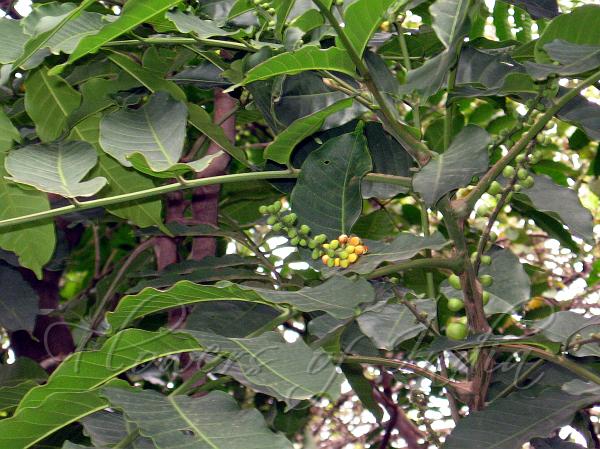
Pithraj Tree is a deciduous tree native to India, growing to 20-30 m tall.
Leaves are odd- or even- pinnate, 30-60 cm long, with 9-21 leaflets.
Leaflets are oblong-elliptic, elliptic, or ovate, 17-26 × 4-10 cm with
basal pair smallest, leathery when mature, with visible transparent tiny
spots under sunlight. Base of the leaflets is oblique, margin entire.
Flower clusters occur in leaf axils, less than a foot long. Flowers are 6-7 mm in
diameter, with 3 bracteoles. Flowers have 5 nearly curcular sepals, 1-1.5
mm across. Petals are 3-7 mm in diameter, concave. Staminal tube is
spherical, smooth. Anthers are 5 or 6, oblong. Capsule is sort of ovoid,
2-2.5 × 2.5-3 cm, orangish when mature. Seeds are greyish brown. Pithraj Tree is
found in East Himalaya, Peninsular India, China and SE Asia.
Flowering: May-September.
Medicinal uses: Bark is used in spleen, liver diseases, tumour
and abdominal complaints. Seed-oil is used in rheumatism.
Bark is used in spleen, liver diseases, tumour
and abdominal complaints. Seed-oil is used in rheumatism.
Medicinal uses:
Bark is used in spleen, liver diseases, tumour
and abdominal complaints. Seed-oil is used in rheumatism. | Identification credit: Navendu Pāgé | Photographed in Lal Bagh Botanical Garden, Bangalore and Sundar Nursery, Delhi. |
• Is this flower misidentified? If yes,