
| Porcupine Flower |

|
 |

|


| File size | 216848 |
| Original date | 3/12/06 3:25 PM |
| Resolution | 2048 x 1536 |
| Flash | Flash did not fire, auto |
| Focal length | 8.0mm |
| Exposure time | 1/293s |
| Aperture | 3.2 |
| Focus Distance | |
| Metering Mode | Partial |
| Camera make | NIKON |
| Camera model | E3700 |
| Sensor type |
 |
 ative ative |
 |
 |
Photo: |
Botanical name: Barleria prionitis Family: Acanthaceae (Acanthus family)
Synonyms: Barleria appressa, Barleria coriacea, Barleria spicata
Synonyms: Barleria appressa, Barleria coriacea, Barleria spicata
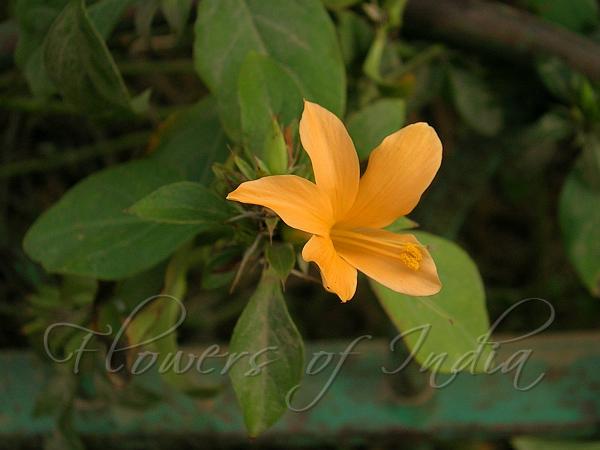
Porcupine flower is an erect, prickly shrub,
usually single-stemmed, growing to about 1.5 m tall.
Spines are about 1.2 cm long. Leaves are up to 5-9 x 2.5-4 cm, elliptic,
pointed, with a fine point, base wedge-shaped, sparsely puberulus, fringed
with hairs on the margins, gland dotted beneath, leaf-stalk up to 2 cm.
Orange-yellow flowers are borne in cymes in leaf-axils; bracts 2, 1.5 cm,
oblong with a fine
point at the tip. Outer sepals are 1.3 x 0.4 cm, inner 1.1 x 0.2 cm,
fine-tipped, hairy. Flower tube is 2.5 cm, petals 2 cm obovate, filaments
1.3 cm, staminodes 2, remaining at the base of the flower tube. Ovary is
2.5 mm, style 2.5 cm. Porcupine flower is found in Tropical Africa and Asia.
Medicinal uses: Porcupine Flower has numerous
medicinal properties including treating fever, respiratory diseases,
toothache, joint pains and a variety of other ailments; and it has
several cosmetic uses. A mouthwash made from root tissue is used to
relieve toothache and treat bleeding gums. The whole plant, leaves, and
roots are used for a variety of purposes in traditional Indian
medicine. For example, the leaves are used to promote healing of wounds
and to relieve joint pains and toothache. Because of its antiseptic
properties, extracts of the plant are incorporated into herbal
cosmetics and hair products to promote skin and scalp health.
Porcupine Flower has numerous
medicinal properties including treating fever, respiratory diseases,
toothache, joint pains and a variety of other ailments; and it has
several cosmetic uses. A mouthwash made from root tissue is used to
relieve toothache and treat bleeding gums. The whole plant, leaves, and
roots are used for a variety of purposes in traditional Indian
medicine. For example, the leaves are used to promote healing of wounds
and to relieve joint pains and toothache. Because of its antiseptic
properties, extracts of the plant are incorporated into herbal
cosmetics and hair products to promote skin and scalp health.
Medicinal uses:
Porcupine Flower has numerous
medicinal properties including treating fever, respiratory diseases,
toothache, joint pains and a variety of other ailments; and it has
several cosmetic uses. A mouthwash made from root tissue is used to
relieve toothache and treat bleeding gums. The whole plant, leaves, and
roots are used for a variety of purposes in traditional Indian
medicine. For example, the leaves are used to promote healing of wounds
and to relieve joint pains and toothache. Because of its antiseptic
properties, extracts of the plant are incorporated into herbal
cosmetics and hair products to promote skin and scalp health. | Identification credit: Thingnam Sophia | Photographed in Delhi. |
• Is this flower misidentified? If yes,