
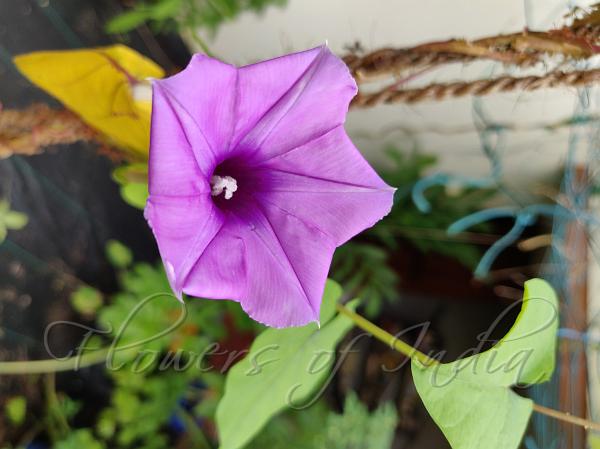
| Purple Moonflower |

|
 |

|


| File size | 541306 |
| Original date | 8/13/20 5:36 PM |
| Resolution | 4608 x 3456 |
| Flash | Flash did not fire, auto |
| Focal length | 4.25mm |
| Exposure time | 1/100s |
| Aperture | 1.7 |
| Focus Distance | |
| Metering Mode | Center weighted average |
| Camera make | OnePlus |
| Camera model | ONEPLUS A6000 |
| Sensor type | MonochromeArea |
 |
 aturalized aturalized |
 |
 |
 |
Photo: |
Botanical name: Ipomoea muricata Family: Convolvulaceae (Morning glory family)
Synonyms: Convolvulus muricatus, Ipomoea turbinata, Ipomoea shirensis
Synonyms: Convolvulus muricatus, Ipomoea turbinata, Ipomoea shirensis
Purple Moonflower is an annual vine growing several
meters high on trellises. Stems are herbaceous and rough due to the
presence of many minute speculate protuberances growing from the
epidermis. Leaves are simple, smooth, soft and entire, the base is
heart-shaped, the lobes are rounded and the tip tapers into a short
caudex. The light green palmately netted-veined blades are 4-9 cm wide
and 6-10 cm long, while the leaf-stalks reach up to 10 cm in length.
Inflorescence is in leaf-axils, one to few flowered. Each flower is
perfect and is held by a flower-cluster-stalk somewhat shorter than the
leaf-stalk. The flower which opens at night is pink-purple, bell-shaped
and funnel-shaped. Fruit is a thin walled capsule, dehiscent by valves,
ovoid with a diameter of 0.8-1.5 cm, 2-3 cm long. Two to four hairless,
black colored seeds are found in each capsule. This is cultivated for
ornament in several countries. In India its fruit is cooked as a
vegetable, and is called Clove Bean. Purple Moonflower is native to
Mexico to Tropical America, but now naturalized all over the tropical
world. It is also found in the Himalayas, at altitudes of 910-1400 m.
| Identification credit: Sundara Bhat K | Photographed in Mangalore, Karnataka. |
• Is this flower misidentified? If yes,