
| Ram Tulsi |

|
 |

|


| File size | 273785 |
| Original date | 11/13/20 10:05 AM |
| Resolution | 1200 x 1800 |
| Flash | Flash fired |
| Focal length | 100.0mm |
| Exposure time | 1/125s |
| Aperture | 11.0 |
| Focus Distance | |
| Metering Mode | Center weighted average |
| Camera make | Canon |
| Camera model | Canon EOS 7D Mark II |
| Sensor type |
 |
 ative ative |
 |
 |
Photo: |
Botanical name: Ocimum gratissimum Family: Lamiaceae (Mint family)
Synonyms: Ocimum suave, Ocimum viride, Ocimum viridiflorum
Synonyms: Ocimum suave, Ocimum viride, Ocimum viridiflorum
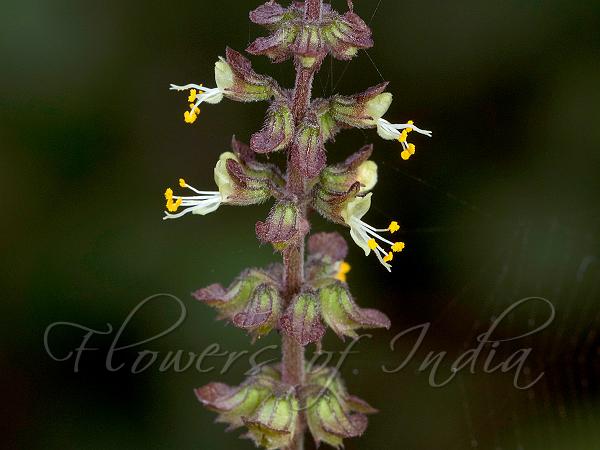
Ram Tulsi is a perennial herb, woody at base. Stems grow to 1-3 m long.
Leaves broadly to narrowly ovate, usually 5-13 cm long, 3-9 cm wide,
surface somewhat hairy. Leaf margin is toothed, tip narrow, base wedge-
shaped. Leaf stalks are 1-6 cm long. Flowers are greenish white to
greenish yellow, 4-7 mm long. Sepal cup is 3-5 mm long, enlarging up to 7
mm long in fruit. Upper sepal is ovate, and the median lobes of the lower
lip are shorter than lateral ones. Nutlets are nearly spherical, 1.5-2 mm
in diameter. The species is distributed world-wide.
| Identification credit: Tabish | Photographed in cultivation. |
• Is this flower misidentified? If yes,