
| Red Sandalwood |

|
 |

|


| File size | 792605 |
| Original date | 4/11/22 3:47 PM |
| Resolution | x |
| Flash | Flash did not fire, auto |
| Focal length | 4.745mm |
| Exposure time | 1/168s |
| Aperture | 1.75 |
| Focus Distance | |
| Metering Mode | $meteringMode |
| Camera make | OnePlus |
| Camera model | GM1901 |
| Sensor type |
 |
 ative ative |
 |
 |
 |
Photo: |
Botanical name: Pterocarpus santalinus Family: Fabaceae (Pea family)
Synonyms: Lingoum santalinum, Draco santalum
Synonyms: Lingoum santalinum, Draco santalum
Red Sandalwood is a small to medium-sized, deciduous
tree upto 11 m tall with a dense, rounded crown. Bark is
blackish-brown, deeply cut into rectangular plates, yielding a deep red
latex when cut; heartwood extremely hard, dark purple. Leaves are
usually imparipinnate, 10-18 cm long; leaflets 3, rarely 4-5, 3.8-7.6
cm long, broadly ovate or round, leathery, tip blunt, slightly notched,
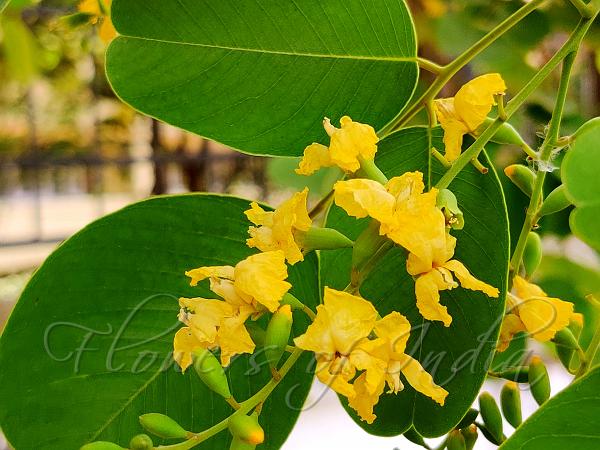
undersurface pale and clothed with fine grey hairs. Flowers are yellow,
borne a few together in simple or sparingly branched racemes;
flower-stalks about 5 mm long; sepal-cup 5-6 mm long, teeth minute,
triangular. Pods are obliquely round, 3.8-5 cm in diameter, including
the wing, base narrowed into a short, concavely curved stipe about 8 mm
long, woolly. Seeds are 1-2, reddish-brown, smooth, leathery, 1-1.5 cm
long. Red Sandalwood is native to South India.
| Identification credit: Jatin Vaity, Mahadeswar Swamy | Photographed in Mumbai & Guindy National park, Chennai. |
• Is this flower misidentified? If yes,