
| Russian Sage |

|
 |

|


| File size | 82843 |
| Original date | 9/19/11 2:47 PM |
| Resolution | 1020 x 765 |
| Flash | Flash did not fire, auto |
| Focal length | 6.0mm |
| Exposure time | 1/500s |
| Aperture | 3.2 |
| Focus Distance | |
| Metering Mode | Center weighted average |
| Camera make | Canon |
| Camera model | Canon PowerShot S5 IS |
| Sensor type | OneChipColorArea |
 |
 ative ative |
 |
 |
Photo: |
Botanical name: Salvia abrotanoides Family: Lamiaceae (Mint family)
Synonyms: Perovskia abrotanoides, Perovskia artemisioides
Synonyms: Perovskia abrotanoides, Perovskia artemisioides
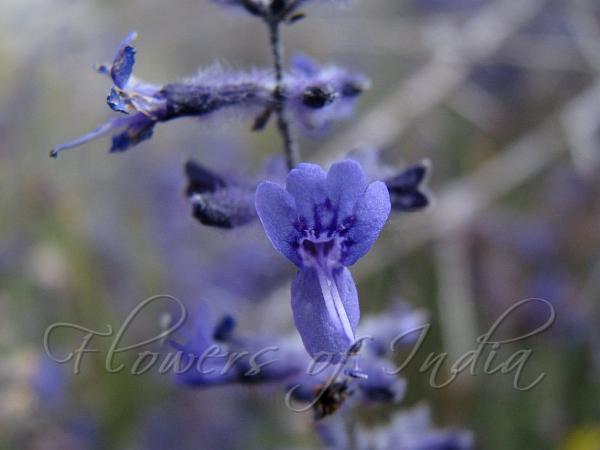
Russian Sage is a subshrub, wide-spreading,
aromatic, up to 1 m tall. Stems are much branched from a thick woody
rootstock, leafy, with very short adpressed hairs and some oil
globules. Leaves are multiply cut, with linear or linear-oblong
ultimate segments, abouts 4-7 x 2.5 cm, below with a dense indumentum
of hairs and numerous oil globules, sometimes shairless, stalk about 1
cm. Flowers are borne in showy, large, much-branched spikes with
2-4-flowered distant clusters. Bracts and bracteoles are present. Sepal
cup is tubular, violet, about 4 mm long in flower, somewhat longer and
broader in fruit, with a dense indumentum of long villous eglandular
hairs, and many oil globules. Flowers are violet blue, rarely white,
about 1 cm long, hairy, tube slightly protruding beyond the sepals.
Upper lip is apparently 4-lobed, reflexed; lower lip 1-lobed, entire.
Stamens are either clearly protruding or included, filaments often
mauve. Style included or clearly protruding with a broadly bilobed
stigma. Nutlets are ovoid, smooth, dark brown, about 2 x 1 mm.
Russian Sage is found in E. Iran, Turkmenia, Afghanistan, Soviet
Central Asia, Pakistan, Kashmir and Tibet, at altitudes of 2000-3500 m.
Flowering: May-August.
Medicinal uses: Russian Sage is locally used for treating headache, typhoid, atherosclerosis,
toothache, cough, liver fibrosis, and gonorrhea cardiovascular diseases in Iran.
It is used to control painful urination and fever in Ladakh.
Russian Sage is locally used for treating headache, typhoid, atherosclerosis,
toothache, cough, liver fibrosis, and gonorrhea cardiovascular diseases in Iran.
It is used to control painful urination and fever in Ladakh.
Medicinal uses:
Russian Sage is locally used for treating headache, typhoid, atherosclerosis,
toothache, cough, liver fibrosis, and gonorrhea cardiovascular diseases in Iran.
It is used to control painful urination and fever in Ladakh.
| Identification credit: Prashant Awale | Photographed in Sasuma, Ladakh. |
• Is this flower misidentified? If yes,